


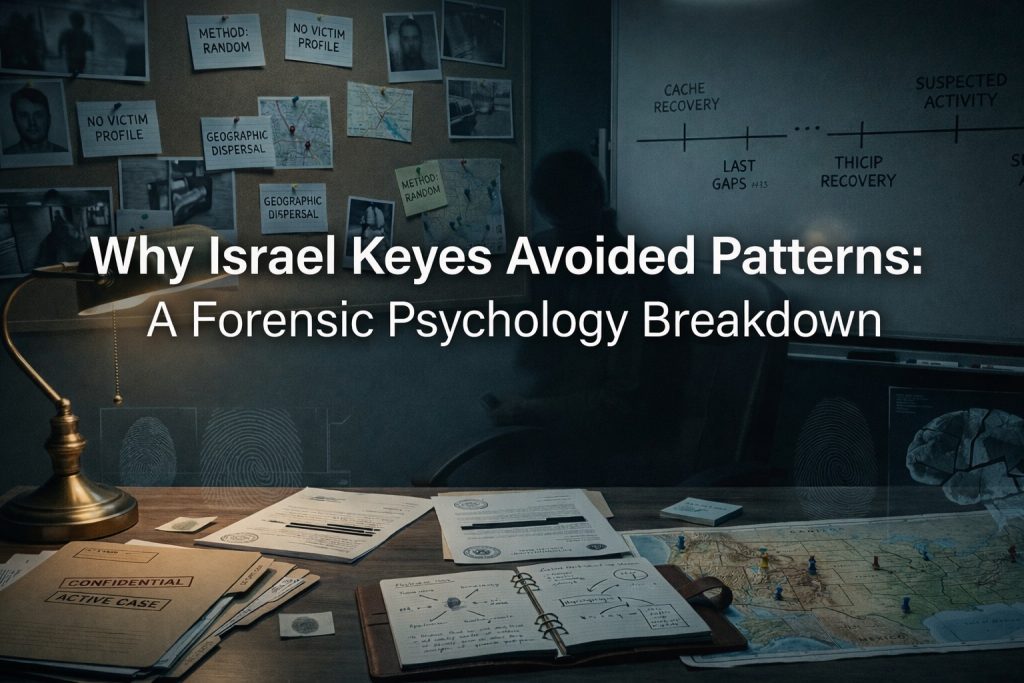
Most serial killers leave patterns.
They return to familiar locations.
They target similar victims.
They repeat rituals.
Patterns are how investigators connect crimes. Patterns are how profilers understand behavior. Patterns are how the Federal Bureau of Investigation builds psychological frameworks around offenders.
But Israel Keyes did something different.
He deliberately avoided patterns.
He crossed state lines.
He buried “kill kits” years in advance.
He selected victims with no obvious connection to himself.
He varied methods.
This wasn’t randomness.
It was a strategy.
And from a forensic psychology perspective, his refusal to follow patterns may be the most revealing part of his criminal psychology.
The Traditional Serial Killer Model
To understand why Keyes is psychologically significant, we first need to understand what investigators typically expect.
Serial offenders usually demonstrate:
- Geographic clustering
- Consistent victimology
- Ritualistic elements
- Escalation cycles
- Behavioral signatures
Repetition happens because crime is often driven by fantasy. Over time, fantasy narrows. The offender seeks similar experiences to recreate internal gratification.
Patterns aren’t just investigative clues, they are psychological comfort zones.
Keyes rejected that comfort.
The Kill Kits: Long-Term Cognitive Planning
One of the most chilling aspects of the case was his “kill kits.”
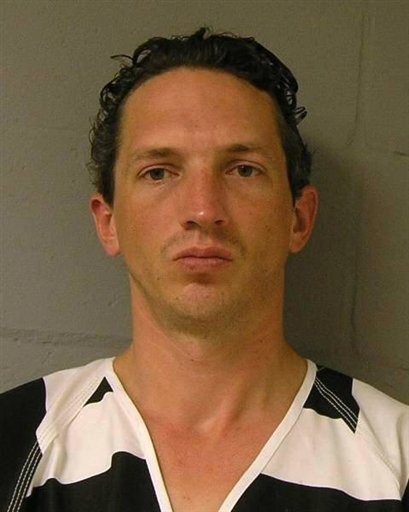
He buried containers across multiple U.S. states containing:
- Firearms
- Ammunition
- Cash
- Zip ties
- Tools
Some were hidden years before he used them.
This level of preparation demonstrates:
- Advanced executive functioning
- Patience
- Emotional detachment
- Long-term strategic thinking
Most serial offenders escalate impulsively. Keyes escalated structurally.
He planned before the opportunity presented itself.
That is not emotional chaos.
That is cognitive control.
Why Avoid Patterns at All?
This is the central psychological question.
Why would a serial offender intentionally avoid leaving behavioral consistency?
Because patterns create vulnerability.
Profilers analyze repetition to predict:
- Where the offender lives
- What type of victim they prefer
- What motivates them
- How they escalate
By removing patterns, Keyes reduced predictive exposure.
From a forensic psychology standpoint, this suggests:
- Intellectual awareness of profiling methods
- Anti-authority personality traits
- Narcissistic superiority
- Desire for systemic control
He wasn’t only committing crimes.
He was trying to outmaneuver the system designed to stop him.
Organized Offender But Evolved
In traditional profiling models, offenders are often categorized as organized or disorganized.
Keyes clearly falls into the organized category:
✔ He brought tools
✔ He controlled environments
✔ He minimized forensic evidence
✔ He maintained employment and relationships
But most organized offenders still repeat behaviors.
Keyes diversified them.
He varied:
- Victim age
- Location
- State
- Method
This increased cognitive complexity. Maintaining unpredictability requires discipline.
It also suggests high impulse regulation, something many violent offenders lack.
The Psychology of Control
Control appears to be the underlying psychological driver.
Serial offenders often seek dominance over victims.
Keyes appeared to seek dominance over:
- Law enforcement
- Investigative structures
- Psychological profiling
- Public narrative
Avoiding patterns allowed him to feel:
- Unpredictable
- Undefined
- Untraceable
Control over unpredictability reinforced his internal sense of superiority.
Geographic Randomization as Strategy
Most serial killers operate within familiar regions. It reduces anxiety and logistical risk.
Keyes did the opposite.
He flew into different states, rented cars, drove long distances, and chose random targets.
This behavior demonstrates:
- Risk tolerance
- Emotional detachment from community
- Lack of territorial identity
- Strategic disconnection
Geographic diversification complicates investigative linkage.
From a profiling perspective, it disrupts geographic mapping models that rely on clustering.
This was intentional.
Compartmentalization and the Double Life
Perhaps most psychologically disturbing was his ability to maintain a normal outward life.
He worked.
He socialized.
He blended in.
This requires compartmentalization, the mental separation of identities.
Compartmentalization allows offenders to:
- Separate violence from daily functioning
- Avoid emotional leakage
- Sustain long-term secrecy
Patterns threaten compartments.
Patterns create trails.
Trails collapse psychological separation.
By avoiding patterns, he protected his double life.
Expert Insight: What Dr. John Mayer Says About Pattern Disruption
At PodCandy, we emphasize behavioral science over sensational storytelling. And cases like this highlight why forensic psychology matters.
According to forensic psychologist Dr. John Mayer’s framework, consistency in crime behavior typically reflects internal fantasy reinforcement. Repetition reveals psychological drivers.
When an offender intentionally disrupts repetition, it signals something different.
Pattern avoidance may indicate:
- High-functioning psychopathy
- Strategic cognition
- Grandiosity
- Narcissistic intellectual competition
- Severe emotional detachment
Rather than being driven purely by compulsive urges, the offender may be driven by calculated dominance.
Dr. Mayer often explains that profiling works because human behavior seeks efficiency. We repeat what works.
When someone resists that repetition, it suggests conscious deviation, a deliberate attempt to remain undefined.
In Keyes’ case, unpredictability became part of his psychological identity.
He wasn’t just committing crimes.
He was engineering invisibility.
Narcissism and Intellectual Superiority
Several behavioral elements suggest narcissistic traits:
- Belief he was smarter than investigators
- Awareness of law enforcement methods
- Selective cooperation during interrogation
- Withholding full confessions
Avoiding patterns reinforced that self-image.
If investigators could not categorize him, he remained psychologically superior in his own narrative.
This reflects a competitive mindset not just against victims, but against institutions.
Why Pattern Avoidance Eventually Failed
Despite all strategic planning, Keyes was eventually captured due to financial activity after a kidnapping.
This reinforces a critical forensic principle:
No offender is perfect.
Maintaining unpredictability requires constant vigilance. Over time, confidence increases. Overconfidence leads to mistakes.
Cognitive fatigue, routine life stressors, and human error eventually create cracks.
Even highly organized offenders are vulnerable to behavioral leakage.
What This Case Changed in Profiling
The case forced investigators to reconsider assumptions.
It demonstrated:
- Not all serial offenders operate locally
- Victimology may not always be consistent
- Organized offenders can intentionally diversify behavior
- Geographic profiling has limits
Profiling evolved to account for adaptive offenders who intentionally manipulate expectations.
Keyes represented a more self-aware serial offender model.
That awareness makes the case psychologically significant.
The Bigger Psychological Meaning
Avoiding patterns wasn’t accidental.
It was identity protection.
Predictability creates labels.
Labels create vulnerability.
Vulnerability reduces power.
By refusing to repeat behaviors, Keyes maintained:
- Autonomy
- Secrecy
- Psychological dominance
From a forensic perspective, this suggests a blend of psychopathy, narcissism, and high-level cognitive planning.
His crimes were structured exercises in control.
Final Thoughts
Most serial offenders are caught because patterns expose them.
Israel Keyes tried to eliminate that exposure.
He buried preparation years in advance.
He crossed state lines without attachment.
He diversified behavior to frustrate profiling.
But even calculated unpredictability cannot eliminate human imperfection.
Sometimes, the absence of a pattern becomes the pattern itself.
And cases like this remind us why forensic psychology remains essential because understanding behavior is the only way to anticipate it.