


Imagine Going to Work and Never Coming Home
For most teenagers, a part-time job is a symbol of independence. It is a place to earn a paycheck, spend time with friends, and begin learning the responsibilities of adulthood. On the evening of December 6, 1991, four teenage girls in Austin, Texas, expected nothing more than an ordinary Friday night.
Instead, that night became one of the darkest chapters in Texas history.
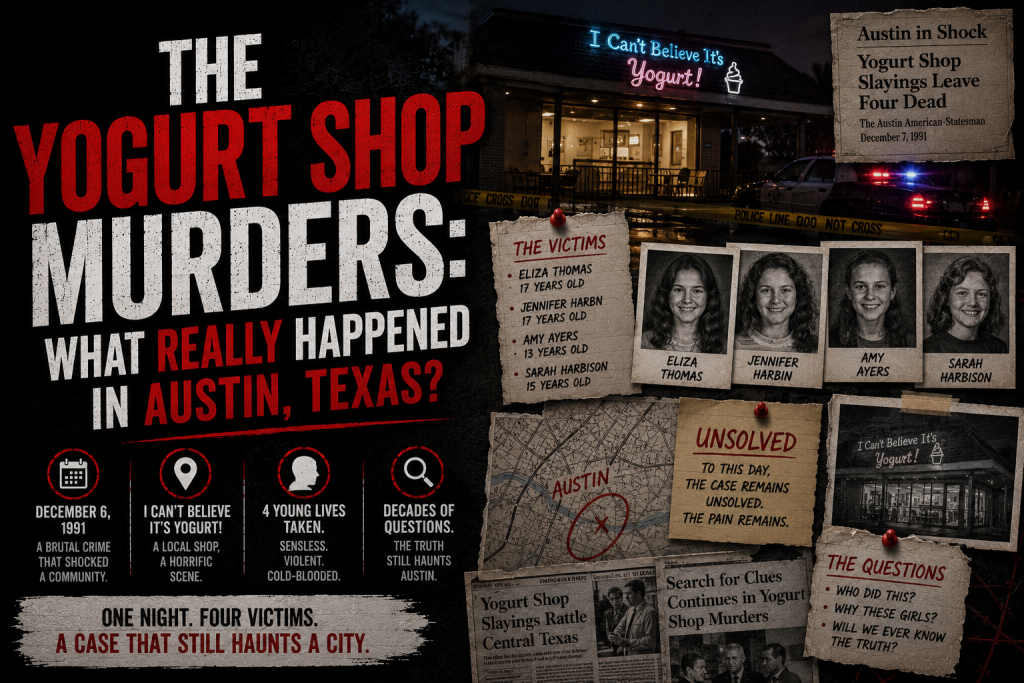
Jennifer Harbison and Eliza Thomas were working the closing shift at an I Can’t Believe It’s Yogurt! store on West Anderson Lane. Jennifer’s younger sister, Sarah Harbison, and her friend Amy Ayers had stopped by to wait for Jennifer so they could all leave together.
They never made it home.
Hours later, firefighters responded to reports of smoke coming from the yogurt shop. After extinguishing the fire, they made a horrifying discovery. Inside the burned building were the bodies of all four girls. Each had suffered unimaginable violence before the fire was deliberately set, apparently in an attempt to destroy evidence.
The brutality of the crime shocked Austin, captured national attention, and launched one of the largest homicide investigations in Texas history.
More than thirty years later, the Yogurt Shop Murders continue to raise difficult questions about justice, forensic science, and the lasting emotional impact of violent crime.
At PodCandy Podcast, cases like this are explored with compassion and responsibility. Rather than focusing only on the shocking details, Dr. John Mayer examines the psychology behind criminal behavior, investigative challenges, and the emotional scars left on families and communities. The Yogurt Shop Murders are not simply a true crime story, they are a reminder of how a single night can forever change countless lives.
Listen to the PodCandy Podcast Episode on The Yogurt Shop Murders
The Yogurt Shop Murders remain one of the most heartbreaking unsolved crime stories in American history. While many people know the basic facts, the deeper story involves investigative mistakes, false confessions, evolving forensic science, and decades of unanswered questions.
In the PodCandy Podcast episode covering this case, we explore the timeline, the victims, the investigation, and the psychological aspects that continue to fascinate criminologists today. With the insights of Dr. John Mayer, the discussion goes beyond headlines to examine why violent offenders behave the way they do and how communities cope after unimaginable tragedy.
Whether you’re interested in criminal psychology, cold cases, or the evolution of forensic science, this episode provides a thoughtful look at one of Texas’ most infamous murder investigations.
What Happened on December 6, 1991?
Friday evenings were usually busy at the yogurt shop. Customers came and went throughout the day, and by closing time the employees were finishing routine tasks before locking the doors.
Jennifer Harbison, age 17, and Eliza Thomas, also 17, were working their scheduled shift. Jennifer’s younger sister Sarah, only 15 years old, arrived with her friend Amy Ayers, who was just 13. The girls planned to leave together once Jennifer finished cleaning the store.
At some point after closing, unknown individuals entered the shop.
Investigators believe the girls were confronted, restrained, and robbed. The situation quickly escalated into one of extraordinary violence. The victims were bound, assaulted, and fatally shot before the offenders intentionally set the building on fire.
The blaze was likely started to destroy physical evidence and delay the investigation.
Instead, it created one of the most disturbing crime scenes Austin detectives had ever encountered.
News of the murders spread rapidly throughout the city. Parents feared for their children. Businesses reviewed their security procedures. Teenagers who worked evening jobs suddenly faced concerns that had never existed before.
The Yogurt Shop Murders were no longer just a criminal investigation they became a tragedy that affected an entire community.
Who Were the Four Victims?
One of the greatest responsibilities of ethical true crime storytelling is remembering the victims as people rather than statistics.
Behind every headline were four young girls with families, dreams, friendships, and futures that were stolen far too soon.
Jennifer Harbison
Jennifer Harbison was seventeen years old and worked at the yogurt shop. Friends described her as responsible and caring. Like many teenagers, she balanced school, work, and spending time with family. On the night of December 6, she was simply finishing another work shift.
Eliza Thomas
Eliza Thomas also worked at the yogurt shop and was seventeen years old. She and Jennifer expected an ordinary evening of closing the store before heading home.
Instead, both young women became victims while simply doing their jobs.
Sarah Harbison
Sarah was Jennifer’s younger sister. At only fifteen years old, she had stopped by the store to wait for Jennifer so they could leave together.
She never imagined that waiting for her sister would become the final moments of her life.
Amy Ayers
Amy Ayers was the youngest victim at just thirteen years old.
She had accompanied Sarah to the yogurt shop that evening.
Like the others, she was simply in the wrong place at the wrong time.
At PodCandy Podcast, Dr. John Mayer often reminds listeners that true crime should never lose sight of the people behind the case. These four girls were daughters, sisters, students, and friends long before they became victims in one of America’s most notorious murder investigations.
Austin Responds to an Unthinkable Crime
The murders left Austin in shock.
Violent crime was not unheard of, but crimes involving multiple teenage victims inside a neighborhood business were almost unimaginable.
Parents questioned whether their children were safe working evening shifts.
Businesses strengthened security procedures.
Residents became more cautious about ordinary routines they had once taken for granted.
The emotional impact extended far beyond the victims’ families.
The entire city experienced a profound loss of innocence.
Cases involving young victims often create long-lasting psychological effects because they challenge our most basic assumptions about safety. A workplace, particularly one filled with teenagers serving frozen yogurt, seemed like one of the least likely places for such violence to occur.
That contrast between normal life and unimaginable tragedy is one reason the Yogurt Shop Murders continue to resonate decades later.
The Investigation Begins
Within hours, investigators launched one of the largest homicide investigations in Austin’s history.
Detectives interviewed hundreds of witnesses.
Thousands of tips poured in.
Evidence was collected from the damaged building despite the challenges created by the fire.
The investigation quickly became extraordinarily complex.
Because the offenders had attempted to destroy the crime scene, many valuable pieces of physical evidence were either damaged or lost.
Forensic science in the early 1990s was also far less advanced than it is today.
DNA testing was still developing.
Crime scene analysis lacked many of the technologies investigators now consider standard.
As a result, detectives relied heavily on witness interviews, physical evidence that survived the fire, and traditional investigative methods.
Despite years of work, no immediate breakthrough came.
The mystery only deepened.
False Confessions and Investigative Challenges
As public attention increased, investigators received an astonishing number of leads.
Over time, dozens of individuals either became suspects or falsely confessed to involvement in the murders.
Eventually, four young men were charged.
Two were convicted.
However, years later those convictions were overturned after courts identified serious legal issues and DNA evidence failed to support the prosecution’s theory.
The case once again returned to uncertainty.
This aspect of the investigation highlights one of the most important lessons in criminal justice.
A confession alone is not proof of guilt.
As Dr. John Mayer frequently explains on PodCandy Podcast, false confessions occur for many psychological reasons, including intense interrogation, fear, confusion, mental vulnerability, or the desire to satisfy investigators.
Understanding these psychological dynamics has become an increasingly important part of modern criminal investigations.
The DNA Breakthrough That Changed Everything
For decades, many people believed the Yogurt Shop Murders would never be solved.
The evidence had been damaged by fire.
The original investigation had produced controversial confessions.
Two convictions had already been overturned.
Families had spent years hoping for answers that never came.
Yet while the case appeared frozen in time, forensic science continued to evolve.
Throughout the 2000s and 2010s, advances in DNA technology transformed criminal investigations across the United States. Cases that once seemed impossible suddenly became solvable through improved laboratory testing and investigative genetic genealogy.
The Yogurt Shop Murders became one of those cases.
Investigators carefully preserved biological evidence from the original crime scene. Although technology in 1991 could not fully analyze it, modern forensic science made it possible to revisit evidence that had remained silent for decades.
Years later, DNA testing identified Robert Eugene Brashers, a violent offender who had died in 1999, as the source of biological evidence connected to the crime scene.
For many investigators, it represented the most significant development since the murders occurred.
While Brashers could never face trial because he was already deceased, the discovery dramatically reshaped the investigation.
It also demonstrated something incredibly important.
Science keeps improving.
Evidence that appears meaningless today may become the key to solving tomorrow’s cold cases.
Why Modern Forensic Science Matters
The Yogurt Shop Murders highlight just how dramatically criminal investigations have changed over the last three decades.
In 1991, investigators had limited DNA technology.
Crime scene reconstruction was far less advanced.
National forensic databases were still developing.
Today, detectives have access to:
- Advanced DNA sequencing
- Genetic genealogy
- Digital forensic databases
- Enhanced fingerprint analysis
- Artificial intelligence-assisted evidence comparison
These advancements have solved hundreds of cold cases that investigators once believed impossible to close.
For families of victims, every technological breakthrough represents renewed hope.
At PodCandy Podcast, Dr. John Mayer frequently discusses how science and psychology now work together in criminal investigations. While forensic evidence identifies physical facts, behavioral science helps investigators understand offender decision-making and criminal patterns.
Together, these disciplines continue transforming modern law enforcement.
The Psychology Behind Crimes Like This
One of the most difficult questions in any violent crime is also the simplest.
Why?
Why would someone attack four teenage girls?
Why commit such extraordinary violence?
Why attempt to destroy the crime scene?
Although no one can know the exact thoughts of the offender without a confession, forensic psychology helps us understand behaviors commonly associated with crimes of this nature.
According to Dr. John Mayer, violent offenders often display combinations of control, impulsivity, emotional instability, and a willingness to dehumanize victims.
Mass attacks involving multiple victims frequently involve offenders who seek domination over others rather than personal relationships with specific individuals.
In cases involving robbery, violence sometimes escalates unexpectedly once offenders believe witnesses may identify them.
Again, psychology cannot prove motive.
It can only help explain behavioral possibilities supported by evidence.
That distinction remains central to every discussion on PodCandy Podcast.
The Lasting Impact on Austin
The Yogurt Shop Murders permanently changed Austin.
Before the murders, many families viewed part-time jobs as ordinary teenage responsibilities.
After the murders, parents worried about late-night work schedules.
Businesses reviewed security procedures.
Employees became more cautious about closing stores after dark.
The emotional effects extended far beyond the crime scene.
For the families, grief never truly ended.
Birthdays.
Graduations.
Holidays.
Every milestone became another reminder of lives interrupted.
Communities often remember exactly where they were when tragedies like this occur.
Even decades later, longtime Austin residents continue discussing the case.
Not because they enjoy the mystery.
Because they remember the loss.
What The Yogurt Shop Murders Teach Us
Every criminal investigation leaves lessons behind.
The Yogurt Shop Murders demonstrate several that remain relevant today.
Evidence Must Be Protected
The intentional fire complicated one of the most important homicide investigations in Texas history.
Crime scene preservation remains one of the most critical aspects of modern policing.
False Confessions Can Mislead Investigations
Confessions alone should never determine guilt.
Reliable forensic evidence remains essential.
Cold Cases Deserve Continued Attention
Scientific advances continue solving crimes decades after they occur.
Families should never lose hope simply because time has passed.
Victims Must Remain the Focus
True crime should never become entertainment at the expense of victims.
Every headline represents real people whose lives mattered long before the crime occurred.
This philosophy remains central to PodCandy Podcast, where Dr. John Mayer emphasizes compassion alongside investigation.
Why Cases Like This Continue to Fascinate Us
People often wonder why society remains interested in crimes committed decades ago.
The answer is not simply curiosity.
Unsolved—or long-unsolved—cases challenge our understanding of justice.
They force us to confront uncomfortable questions.
Can every crime eventually be solved?
How reliable are eyewitnesses?
How much should investigators rely on confessions?
Can science succeed where traditional investigations failed?
These questions make cases like the Yogurt Shop Murders important far beyond Texas.
They shape the future of criminal investigations.
Final Thoughts
The Yogurt Shop Murders remain one of the most heartbreaking crimes in modern American history.
Four teenage girls left for what should have been an ordinary evening.
None of them returned home.
Their families waited decades for meaningful answers.
Investigators spent years following leads, conducting interviews, and revisiting evidence.
Only through advances in forensic science did the investigation finally experience its most significant breakthrough.
Yet even with modern DNA evidence, the tragedy itself can never be undone.
At PodCandy Podcast, stories like the Yogurt Shop Murders are explored not to sensationalize violence but to better understand the people, psychology, and investigative work behind these cases.
Through the forensic psychology perspective of Dr. John Mayer, listeners are encouraged to look beyond the headlines and consider the deeper lessons every investigation offers.
The Yogurt Shop Murders remind us that justice is sometimes delayed, but the search for truth never truly ends.
Behind every cold case are families still remembering.
Communities still grieving.
Investigators still searching.
And victims who deserve never to be forgotten.
Whether the case is viewed through the lens of forensic science, criminal psychology, or human compassion, one truth remains unchanged:
The four young girls who entered a yogurt shop on December 6, 1991, should have gone home that night.
Their story deserves to be remembered—not simply as one of America’s most infamous murder cases, but as a reminder of why justice, truth, and empathy remain at the heart of every responsible true crime investigation.