


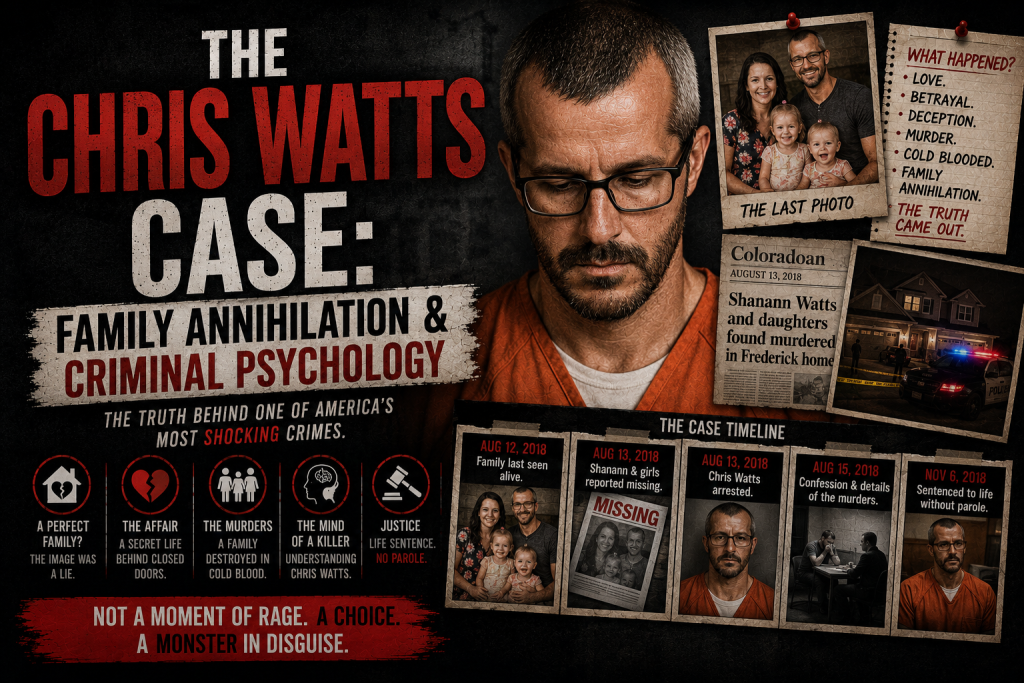
How Could a Seemingly Ordinary Husband Murder His Own Family?
On the surface, Chris Watts appeared to have an ordinary life.
He was a husband.
A father.
A neighbor.
A coworker.
Social media showed smiling family photos, birthday celebrations, vacations, and everyday moments that looked no different from thousands of other American families.
Then, in August 2018, everything changed.
His pregnant wife, Shanann Watts, and their two young daughters, Bella and Celeste, disappeared from their home in Frederick, Colorado. Within days, investigators uncovered one of the most shocking family murder cases in recent American history. Chris Watts eventually confessed to killing his wife and children, forever changing the lives of everyone connected to the case.
The Watts family murders continue to fascinate criminologists, psychologists, investigators, and true crime audiences because they challenge one of society’s strongest assumptions: that home is the safest place for a family.
At PodCandy Podcast, cases like this are examined with compassion, evidence, and psychological insight. Rather than sensationalizing violence, Dr. John Mayer explores the behavioral patterns, decision-making, and warning signs that can help us better understand crimes that appear almost impossible to comprehend.
This is not simply the story of Chris Watts.
It is the story of Shanann Watts.
It is the story of Bella and Celeste.
It is the story of a family whose future was stolen.
And it is a reminder that behind every true crime headline are real people whose lives deserve to be remembered.
Who Was Chris Watts?
Before the murders, Chris Watts was widely described as quiet, reserved, and hardworking.
He lived with his wife, Shanann Watts, and their daughters, Bella and Celeste, in Frederick, Colorado. The family appeared happy on social media, where Shanann often shared updates about family life, parenting, and her work.
Like many family annihilation cases, the contrast between public appearance and private reality became one of the most disturbing aspects of the investigation.
Friends later described the family as loving and close. When Shanann and the children suddenly disappeared, those closest to them immediately sensed that something was terribly wrong.
The disappearance quickly transformed from a missing persons investigation into a homicide investigation.
Timeline of the Chris Watts Case
The events unfolded rapidly during August 2018.
| Date | Event |
| August 13, 2018 | Shanann Watts and her daughters were reported missing. |
| August 14–15 | Investigators interviewed Chris Watts and gathered evidence. |
| August 15 | Chris Watts was arrested after inconsistencies emerged during questioning. |
| August 16 | The bodies of Shanann, Bella, and Celeste were discovered. |
| November 2018 | Chris Watts pleaded guilty to multiple counts of murder. |
| November 2018 | He received multiple life sentences without the possibility of parole. |
Although the timeline spans only a few days, the emotional impact continues years later.
Understanding Family Annihilation
Criminologists use the term family annihilation to describe cases in which an individual kills multiple members of their own family, often including a spouse and children.
These crimes are rare but deeply disturbing because they violate one of the strongest social expectations: that parents protect their children.
There is no single explanation for why family annihilators commit these crimes.
Researchers have discussed factors that may appear in different cases, including relationship conflict, financial stress, desire for control, fear of consequences, and personality-related issues. Every case, however, has its own unique circumstances and should be evaluated based on the available evidence.
As Dr. John Mayer explains on PodCandy Podcast, forensic psychology does not excuse criminal behavior. Instead, it seeks to understand the decisions, thought processes, and behavioral patterns that may help investigators interpret evidence and, potentially, prevent future tragedies.
The Investigation
Investigators quickly noticed inconsistencies between Chris Watts’ statements and the available evidence.
Security footage, witness interviews, digital evidence, and forensic analysis gradually built a picture that conflicted with his public appeals for his family’s safe return.
Rather than relying on a single piece of evidence, detectives combined multiple investigative techniques to understand what had happened.
The case demonstrated how modern homicide investigations increasingly depend on surveillance technology, digital records, interviews, forensic science, and behavioral observation working together.
Every step brought investigators closer to the truth.
Why This Case Still Matters
The Chris Watts case remains one of the most discussed true crime stories of the modern era because it raises difficult questions about deception, relationships, and human behavior.
How can someone appear ordinary while hiding violent intentions?
Can warning signs always be recognized?
What role does psychology play in understanding crimes like these?
While there are no simple answers, studying cases responsibly helps investigators, researchers, psychologists, and the public better understand the complexity of violent crime.
At PodCandy Podcast, Dr. John Mayer emphasizes that ethical true crime should focus not on creating sensational stories but on learning from real events, honoring victims, and encouraging informed discussion about criminal behavior.
In the Watts case, the names that deserve to be remembered most are not those of the offender, but of Shanann Watts, Bella Watts, Celeste Watts, and Shanann’s unborn son, Nico.
Their story is ultimately one of loss, remembrance, and the importance of seeking truth through evidence rather than speculation.
The Investigation: How Detectives Uncovered the Truth
When Shanann Watts and her daughters were reported missing on August 13, 2018, investigators initially treated the situation as a missing-person case. Friends and family immediately noticed that Shanann had stopped responding to calls and messages, something they considered completely out of character.
One of the first people to raise the alarm was Shanann’s close friend, who contacted authorities after becoming concerned that she could not reach her. Officers arrived at the Watts family home, where Chris Watts appeared cooperative and expressed concern about his family’s disappearance.
At first glance, there were few obvious signs of violence inside the home.
However, experienced investigators understand that the absence of visible evidence does not necessarily mean no crime has occurred.
As Dr. John Mayer often explains on PodCandy Podcast, investigators pay close attention not only to physical evidence but also to behavior. Body language, inconsistencies, emotional responses, and changing statements can all become important pieces of an investigation.
The Importance of Digital Evidence
The Chris Watts investigation demonstrated how modern technology has transformed criminal investigations.
Detectives examined:
- Home security footage
- Phone records
- GPS data
- Vehicle movements
- Text messages
- Social media activity
- Financial records
Each source provided another piece of the puzzle.
One particularly significant development came from surveillance footage collected from a nearby home. Investigators reviewed video showing Chris Watts loading his truck during the early morning hours on the day his family disappeared.
Although the footage did not directly show a crime, it became an important part of the overall investigation because it conflicted with parts of his public statements.
Modern homicide investigations rarely rely on a single breakthrough.
Instead, detectives combine many small pieces of evidence until a clear picture begins to emerge.
Media Attention and Public Appeals
As the search continued, Chris Watts appeared in television interviews asking for his family’s safe return.
Public appeals by family members are common during missing-person investigations.
Investigators, however, continue collecting evidence regardless of public appearances.
Detectives compare public statements with known facts, witness interviews, timelines, and forensic evidence.
When inconsistencies begin to appear, investigators adjust their focus accordingly.
The Watts case became an example of how criminal investigations often progress quietly behind the scenes while the public sees only a small portion of the evidence being gathered.
The Confession
As investigators continued questioning Chris Watts and reviewing evidence, his account of events changed.
He eventually admitted responsibility for the deaths.
Later court proceedings established that Shanann Watts, Bella Watts, Celeste Watts, and Shanann’s unborn son, Nico, had all been murdered.
The confession brought answers to investigators, but it could never repair the devastating loss experienced by the victims’ families.
For many people following the case, the confession raised an even more difficult question.
Why?
Why would a father kill his own children?
Why would a husband murder his pregnant wife?
Those questions remain central to discussions surrounding the case today.
Understanding Family Annihilation Through Criminal Psychology
The Watts case is frequently discussed in relation to family annihilation, a term used in criminology to describe situations in which an individual kills multiple members of their own family.
Although these crimes receive widespread attention, they are extremely rare.
Researchers have identified several patterns that sometimes appear in family annihilation cases, including:
- Relationship breakdown
- Fear of financial consequences
- Desire to escape responsibilities
- Need for control
- Narcissistic personality traits in some offenders
It is important to remember that these are general research findings, not explanations for every individual case.
Human behavior is complex.
Every investigation must rely on evidence rather than assumptions.
According to Dr. John Mayer, understanding criminal psychology does not excuse criminal actions.
Instead, psychology helps investigators understand decision-making, behavioral warning signs, and patterns that may improve future prevention efforts.
Were There Warning Signs?
One of the most common questions people ask after cases like this is whether warning signs existed.
Hindsight often makes behaviors appear obvious.
In reality, warning signs are not always clear before a crime occurs.
Many offenders maintain ordinary jobs.
Healthy friendships.
Normal routines.
Positive public images.
That contrast is one reason family annihilation cases are so disturbing.
The offender often appears completely ordinary until the crime is discovered.
This reminds us that public appearance alone cannot accurately predict private behavior.
The Psychological Impact on Families
True crime discussions often focus heavily on offenders.
But every investigation begins with victims.
Shanann Watts was a daughter, wife, mother, and friend.
Bella and Celeste were children with futures full of possibilities.
Their deaths devastated not only immediate family members but also friends, neighbors, investigators, and entire communities.
At PodCandy Podcast, Dr. John Mayer emphasizes that ethical true crime should never lose sight of the victims.
Understanding criminal psychology is important.
Remembering the people whose lives were taken is even more important.
Why the Chris Watts Case Continues to Fascinate the Public
Years after the murders, documentaries, books, podcasts, and news reports continue discussing the Watts case.
This ongoing interest reflects more than curiosity.
People struggle to understand crimes that seem to contradict everything society believes about family, trust, and safety.
Cases involving strangers often feel distant.
Cases involving spouses and children feel deeply personal.
They force people to ask uncomfortable questions about deception, relationships, and human behavior.
As Dr. John Mayer explains on PodCandy Podcast, forensic psychology cannot always answer why a crime occurred.
However, it can help us better understand how investigators interpret behavior, evaluate evidence, and distinguish fact from speculation.
Lessons From the Chris Watts Case
Several important lessons emerge from this investigation.
Appearances Can Be Misleading
People are not always who they appear to be.
Investigators rely on evidence rather than assumptions.
Digital Evidence Matters
Surveillance footage, phone records, GPS data, and digital communications have become essential tools in modern homicide investigations.
Victims Must Remain the Focus
The purpose of studying true crime should never be to glorify offenders.
It should be to remember victims, understand criminal behavior, and learn lessons that may help prevent future tragedies.
Psychology Supports Justice
Behavioral science cannot replace physical evidence.
However, it provides valuable insight into offender behavior, investigative strategy, and risk assessment.
That combination of evidence and psychology is one of the defining approaches of PodCandy Podcast.
Final Thoughts
The Chris Watts case remains one of the most heartbreaking family homicide investigations in modern American history.
It is remembered not because of the offender alone, but because of the lives that were lost.
Shanann Watts.
Bella Watts.
Celeste Watts.
Nico.
Their story reminds us that every true crime case involves real families whose lives change forever.
At PodCandy Podcast, cases like this are explored responsibly through factual investigation and forensic psychology. Guided by the insights of Dr. John Mayer, the goal is not to sensationalize violence but to encourage thoughtful discussion about criminal behavior, victim remembrance, and the importance of evidence-based investigation.
The Watts case will continue to be studied by investigators, psychologists, and criminologists for years to come not because it offers easy answers, but because it raises difficult questions about trust, deception, and the human mind.
Frequently Asked Questions
Who were the victims in the Chris Watts case?
The victims were Shanann Watts, her daughters Bella Watts and Celeste Watts, and Shanann’s unborn son, Nico.
What is family annihilation?
Family annihilation is a criminological term describing cases in which an individual kills multiple members of their own family, often including a spouse and children.
Why is the Chris Watts case so well known?
The case attracted widespread attention because of its shocking nature, the extensive digital evidence collected during the investigation, and the contrast between Chris Watts’ public image and the crimes he ultimately admitted to committing.
What role does criminal psychology play in cases like this?
Criminal psychology helps investigators understand behavioral patterns, evaluate interviews, identify possible motives, and interpret evidence. It supports investigations but does not replace forensic or legal evidence.
Where can I learn more about the psychology behind true crime?
You can explore more true crime investigations, criminal psychology, and behavioral analysis through PodCandy Podcast, where Dr. John Mayer examines real criminal cases using an evidence-based and ethical approach.