


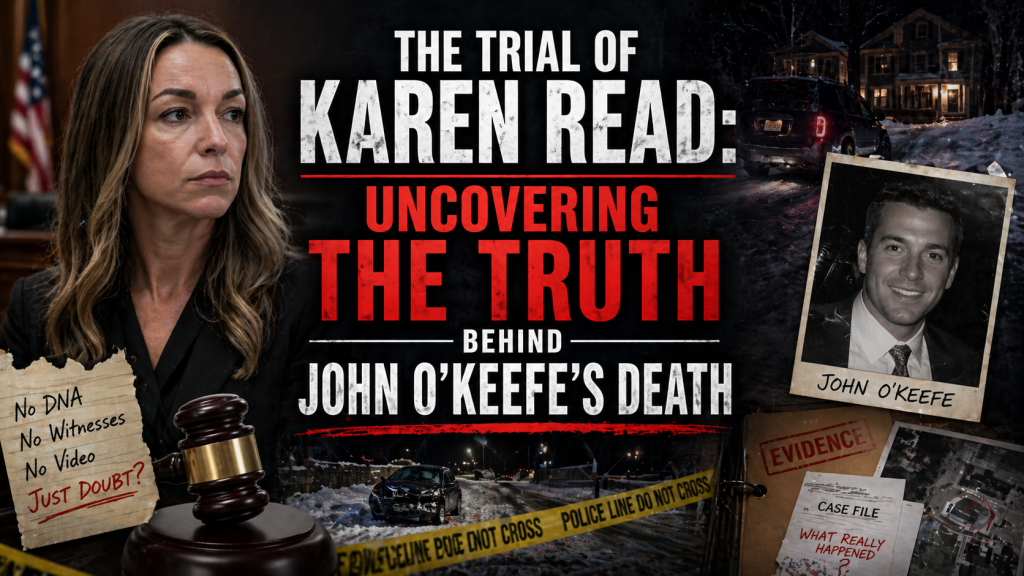
Imagine a snowy January morning in Massachusetts. A Boston police officer is found unresponsive outside a home. His girlfriend becomes the center of a murder investigation. The prosecution says she struck him with her SUV and left him in the cold. The defense says she was framed and that the real truth was buried by a flawed investigation.
That is the unsettling center of the Karen Read case.
John O’Keefe was a Boston police officer whose death in January 2022 became one of the most debated criminal cases in recent American true crime. Karen Read, his girlfriend, was charged in connection with his death and eventually faced two criminal trials. The first trial ended in a mistrial in 2024. In June 2025, a jury found Read not guilty of second-degree murder, manslaughter, and leaving the scene, while convicting her of operating under the influence of alcohol. She received one year of probation on the OUI conviction.
For some, the verdict felt like justice. For others, it felt like another unanswered chapter in the death of John O’Keefe. That is what makes this case so powerful: it is not only about evidence, but also about trust, grief, police accountability, public perception, and the psychology of doubt.
At PodCandy, cases like this are not treated as courtroom drama alone. They are windows into human behavior. PodCandy’s crime coverage frames criminal cases as a way to explore the human mind, motive, and the psychological forces behind disturbing events.
Through a Dr. John Mayer-style forensic psychology lens, the Karen Read trial is not just a legal story. It is a case study in uncertainty, competing narratives, emotional loyalty, public outrage, and the human need to believe that the truth can still be found.
Who Was John O’Keefe?
Before John O’Keefe became the center of a nationally followed trial, he was a Boston police officer, a son, a brother, a friend, and a man whose death devastated the people who loved him.
O’Keefe was found outside a home in Canton, Massachusetts, after a night of drinking and socializing. The case quickly became complicated because many of the people connected to the night were linked to law enforcement circles, which later fueled public scrutiny and competing theories. AP and other outlets reported that prosecutors alleged Karen Read struck O’Keefe with her SUV after a night out, while her defense argued that he was harmed elsewhere and that Read was framed.
In true crime, victims can easily disappear behind the names of suspects, attorneys, witnesses, and online theories. That should not happen here.
John O’Keefe was not just “the officer in the Karen Read case.” He was the person who died. Any responsible discussion of this trial must begin with that reality.
A Dr. John Mayer-style insight is important here: when a case becomes publicly polarizing, the victim can become secondary to the debate. Ethical true crime requires that we keep the human loss at the center, even while examining the investigation and trial.
What Happened the Night Before John O’Keefe Was Found?
The events began on the night of January 28, 2022, and continued into the early morning hours of January 29.
Karen Read and John O’Keefe had been out drinking with others in Canton, Massachusetts. Prosecutors alleged that Read later drove O’Keefe to a house connected to other law enforcement figures and struck him with her Lexus SUV before leaving. The defense rejected that version, arguing that Read did not hit O’Keefe and that the investigation was tainted by conflicts, misconduct, and a rush to blame her.
That split became the entire emotional engine of the case.
One side saw a tragic drunk-driving death.
The other saw a cover-up.
The jury was asked to decide what could be proven beyond a reasonable doubt.
This distinction matters. A criminal trial does not decide every possible truth. It decides whether prosecutors have met the legal burden required to convict. In Read’s case, the 2025 jury did not find the evidence strong enough to convict her of murder, manslaughter, or leaving the scene, but did convict her of OUI.
The Karen Read Case Timeline
The Karen Read case stretched across years of investigation, pretrial litigation, public debate, and two criminal trials.
| Date | Event |
|---|---|
| January 29, 2022 | John O’Keefe was found outside a Canton, Massachusetts home |
| February 2022 | Karen Read was arraigned on initial charges related to O’Keefe’s death |
| June 2022 | Read was indicted on upgraded charges, including second-degree murder |
| April 2024 | First criminal trial began |
| July 1, 2024 | First trial ended in a mistrial after a deadlocked jury |
| April 2025 | Second trial began |
| June 18, 2025 | Read was acquitted of major charges and convicted of OUI |
| 2026 | Civil litigation related to O’Keefe’s death continued |
The first trial ended after jurors could not reach a unanimous verdict. The Massachusetts Supreme Judicial Court and the First Circuit later addressed Read’s double-jeopardy arguments connected to the mistrial, with courts noting that no acquittal had been formally announced in open court during the first trial.
The second trial ended very differently. On June 18, 2025, the jury acquitted Read of the major homicide-related charges and convicted her only of operating under the influence.
In simple terms: the criminal case ended with no murder conviction, no manslaughter conviction, and no conviction for leaving the scene but with a guilty finding for drunk driving.
The Prosecution’s Theory
The prosecution’s argument was that Karen Read struck John O’Keefe with her SUV and left him outside in freezing conditions.
Prosecutors pointed to Read’s drinking, her relationship with O’Keefe, vehicle evidence, taillight fragments, and digital data. During the retrial, AP reported that prosecutors argued Read was intoxicated, that her relationship with O’Keefe was deteriorating, and that physical and digital evidence supported their theory that she hit him with her SUV.
In the prosecution’s story, this was not a mystery inside the house. It was a vehicle-related death outside the home.
But the challenge for prosecutors was proving that theory beyond a reasonable doubt. The defense attacked the reliability of the investigation, the handling of evidence, and the conclusions drawn from forensic and digital data. Ultimately, the jury did not convict Read of the homicide-related charges.
From a psychological perspective, prosecution narratives in high-profile cases often depend on coherence. Jurors are not only evaluating facts; they are also evaluating whether the story makes sense as a whole. If enough pieces feel uncertain, doubt can become decisive.
The Defense’s Theory
Karen Read’s defense presented a very different version of events.
Her attorneys argued that O’Keefe was not killed by Read’s SUV. They suggested he may have been injured elsewhere, possibly inside the home, and that Read was framed through a compromised investigation. They also attacked the credibility of the investigation and raised questions about law enforcement relationships, evidence handling, and alleged misconduct. AP reported that Read’s defense claimed she was framed as part of a police cover-up, while prosecutors rejected that theory.
The defense strategy was not simply to say “Karen Read did not do this.” It was to argue that the investigation itself could not be trusted.
That is powerful in a courtroom because criminal law requires proof beyond a reasonable doubt. The defense does not have to prove an alternate killer. It has to create reasonable doubt about the prosecution’s case.
A Dr. John Mayer-style psychological insight fits here: once trust in an investigation is damaged, every piece of evidence can begin to feel unstable. Jurors may start asking not only “what does this evidence show?” but also “can we trust how this evidence was collected, interpreted, and presented?”
Why the Investigation Became So Controversial
The Karen Read case became controversial because it involved not only a death, but also questions about law enforcement conduct.
The defense focused heavily on the conduct of investigators, including former Massachusetts State Police Trooper Michael Proctor. The case drew attention after offensive and unprofessional messages by Proctor became public during the broader litigation and trial coverage. Multiple outlets reported that Proctor’s conduct became a major point of criticism and that his role in the investigation fueled questions about bias and professionalism.
This does not automatically prove the defense’s cover-up theory. But it does help explain why the case became so polarizing.
For many observers, the issue became larger than Karen Read. It became about whether the public could trust the investigation.
That is why this case drew such intense online attention. People were not only debating one defendant’s guilt or innocence. They were debating police credibility, investigative ethics, small-town relationships, and whether institutions protect their own.
The First Trial: A Mistrial and More Questions
Karen Read’s first criminal trial began in 2024 and ended on July 1, 2024, when the judge declared a mistrial after the jury could not reach a unanimous verdict. The deadlock kept the case alive and intensified public debate.
A mistrial does not mean guilt. It does not mean innocence. It means the jury could not reach a unanimous decision.
But psychologically, mistrials often leave the public even more divided. Supporters of the defendant may see the deadlock as proof the case was weak. Supporters of the prosecution may see it as proof that at least some jurors believed the evidence. The lack of finality creates a vacuum, and public opinion rushes in.
That is exactly what happened here.
The Karen Read case became not only a legal case, but a media event, a social media movement, and a cultural argument about justice.
The Second Trial and the 2025 Verdict
The second trial began in April 2025. This time, jurors returned a verdict.
On June 18, 2025, Karen Read was found not guilty of second-degree murder and other major charges in John O’Keefe’s death. She was found guilty of operating under the influence of alcohol and sentenced to one year of probation. AP reported that the jury deliberated for more than 22 hours before reaching the verdict.
The verdict was emotional and divisive.
Read’s supporters celebrated outside the courthouse. O’Keefe’s family and others connected to him were left with grief, anger, and disappointment. NBC Boston reported that Read spoke outside court after the verdict, saying no one had fought harder for justice for John O’Keefe than she and her team had, while some close to O’Keefe disagreed strongly with that statement.
This is the tragic complexity of the case: a criminal acquittal gave Read legal relief, but it did not give everyone emotional closure.
What the Verdict Means and What It Does Not Mean
The verdict means Karen Read was not criminally convicted of murdering John O’Keefe. It also means she was not convicted of manslaughter or leaving the scene in the criminal retrial. She was convicted of operating under the influence.
But the verdict does not answer every question about how John O’Keefe died.
A not-guilty verdict means the prosecution did not prove the charged crimes beyond a reasonable doubt. It does not necessarily provide a complete factual explanation of the death. That is why the case continues to provoke debate.
For true crime audiences, this is important. Legal truth and emotional truth are not always the same. A jury can reach a legal conclusion while families, communities, and observers still feel unresolved.
Dr. John Mayer’s kind of forensic psychology approach helps explain why. People want trials to provide final answers. But trials are structured around burdens of proof, admissible evidence, legal instructions, and jury deliberation. They are not designed to heal every wound or answer every moral question.
Why This Case Captured Public Attention
The Karen Read trial became a national true crime obsession because it contained several powerful elements at once.
A police officer died.
His girlfriend was accused.
The alleged crime scene involved other law enforcement-connected people.
The defense claimed a cover-up.
The investigation faced serious criticism.
The public split into opposing camps.
The first trial ended without a verdict.
The second trial ended with acquittals on the most serious charges.
This combination made the case feel less like a simple criminal trial and more like a test of institutional trust.
People followed the case because they wanted to know what happened to John O’Keefe. But many also followed because the case raised a broader question: what happens when the public no longer trusts the people investigating the truth?
That is where the psychology becomes intense. When official narratives and defense narratives are completely opposed, people often choose the version that fits their deeper beliefs about power, corruption, gender, policing, and justice.
The Role of Social Media and Public Opinion
The Karen Read case was not confined to the courtroom.
It exploded online.
Supporters, critics, legal commentators, true crime creators, and local activists debated evidence, witnesses, police conduct, and trial strategy. The courtroom became only one part of the story. The public conversation became another.
This can be helpful when public attention exposes weak investigations or keeps pressure on institutions. But it can also be harmful when speculation turns into harassment, misinformation, or attacks on witnesses and families.
High-profile trials can become emotional identity battles. People stop saying “this is my interpretation of the evidence” and begin saying “anyone who disagrees with me is corrupt or blind.” That is dangerous.
A PodCandy-style analysis would remind listeners that true crime should not become team sports. John O’Keefe’s death is not a game. Karen Read’s trial was not entertainment. Real people were harmed, grieving, accused, investigated, celebrated, condemned, and scrutinized.
The Civil Cases After the Criminal Trial
Even after the criminal verdict, legal issues continued.
John O’Keefe’s family filed a wrongful death lawsuit against Karen Read and two Canton bars, alleging Read caused O’Keefe’s death and that the bars overserved her before the incident. NBC Boston reported in March and April 2026 that the civil case was ongoing, with hearings and depositions moving forward.
Civil cases use a different legal standard than criminal cases. A criminal case requires proof beyond a reasonable doubt. A civil case generally involves a lower burden of proof. That means an acquittal in criminal court does not automatically end civil litigation.
AP also reported that Read’s lawyers sought to dismiss parts of the wrongful death lawsuit, while O’Keefe’s family continued pursuing claims connected to his death and the aftermath.
As of 2026, the criminal trial may be over, but the legal aftermath is not.
What We Know and What We Still Do Not Know
What we know is that John O’Keefe died after being found outside a home in Canton, Massachusetts, in January 2022. We know Karen Read was charged, tried twice, and acquitted in 2025 of the major criminal charges related to his death. We know she was convicted of OUI and sentenced to probation.
What we still do not know is the full truth that satisfies everyone.
We do not know whether the public will ever agree on what happened that night.
We do not know whether the civil cases will create new findings or new disclosures.
We do not know whether John O’Keefe’s family will ever feel that justice was done.
We do not know whether Karen Read’s supporters will ever feel that every unanswered question about the investigation has been addressed.
That gap between legal outcome and emotional closure is the heart of the Karen Read case.
The Psychology of Doubt in the Karen Read Trial
Doubt was central to this case.
Doubt about the crash theory.
Doubt about the investigation.
Doubt about witness credibility.
Doubt about motive.
Doubt about police conduct.
Doubt about what happened inside or outside the house.
In criminal law, doubt has a specific role. If the jury has reasonable doubt about the defendant’s guilt, it must acquit. In psychology, doubt has another role: it keeps the mind searching.
That is why cases like this do not end easily in public memory. Even after a verdict, people continue debating because their minds still want the missing piece.
Dr. John Mayer’s perspective would likely focus on how people respond when certainty breaks down. When evidence feels incomplete or institutions feel unreliable, people do not simply accept ambiguity. They build narratives. They look for villains. They search for hidden motives. They want reality to become morally clear.
But real cases are often messier than that.
The Ethics of Covering the Karen Read Case
The Karen Read trial should be covered with care.
It is acceptable to discuss the prosecution’s allegations.
It is not acceptable to state them as proven after the acquittal.
It is acceptable to discuss the defense’s cover-up theory.
It is not acceptable to present it as confirmed fact without legal findings proving it.
It is acceptable to criticize investigative failures.
It is not acceptable to harass witnesses, families, jurors, or private individuals.
It is acceptable to ask what happened to John O’Keefe.
It is not acceptable to forget that a man died and a family is still grieving.
True crime becomes harmful when curiosity loses compassion. A case can be fascinating and still tragic. It can raise questions and still require restraint. It can expose systemic concerns without turning real people into characters.
For PodCandy, this is where Dr. John Mayer’s psychological insight matters most: the purpose of true crime is not to consume pain. The purpose is to understand behavior, examine systems, respect victims, and ask better questions.
Final Thoughts: Did the Trial Uncover the Truth?
The trial of Karen Read gave the public a verdict, but not necessarily a single truth everyone accepts.
Karen Read was acquitted of murder and the major charges connected to John O’Keefe’s death. She was convicted of OUI. John O’Keefe’s family continues to grieve. Civil litigation continues. Public debate continues.
That is why this case remains so powerful.
It sits at the intersection of love, death, alcohol, policing, investigation, public doubt, media pressure, and courtroom strategy.
For some, the case is about a woman wrongly accused.
For others, it is about a family denied justice.
For many, it is about whether the justice system can still be trusted when the investigation itself becomes part of the story.
What happened to John O’Keefe remains the question that started everything. The criminal trial answered what the jury could legally convict Karen Read of. It did not erase the grief, the controversy, or the public hunger for clarity.
Until every unanswered question is resolved, this case will remain more than a trial.
It will remain a mirror.
A mirror of grief.
A mirror of doubt.
A mirror of public mistrust.
And a reminder that in true crime, the search for truth should never forget the human cost.
FAQ
Who was John O’Keefe?
John O’Keefe was a Boston police officer who died after being found outside a home in Canton, Massachusetts, in January 2022. His death became the center of the criminal case against Karen Read.
Who is Karen Read?
Karen Read was John O’Keefe’s girlfriend. She was charged in connection with his death, tried twice, and acquitted in 2025 of the major criminal charges, while being convicted of operating under the influence.
What was Karen Read accused of?
Prosecutors accused Karen Read of striking John O’Keefe with her SUV and leaving him outside in the snow. Read’s defense denied that allegation and argued that she was framed through a flawed investigation.
What was the verdict in the Karen Read trial?
In June 2025, Karen Read was found not guilty of second-degree murder and other major charges in John O’Keefe’s death. She was found guilty of operating under the influence and sentenced to one year of probation.
Did the first Karen Read trial end in a mistrial?
Yes. The first trial ended in July 2024 after the jury could not reach a unanimous verdict.
Is there still a civil case related to John O’Keefe’s death?
Yes. John O’Keefe’s family filed a wrongful death lawsuit against Karen Read and two Canton bars. As of 2026, civil proceedings were ongoing.
Why did the Karen Read case become so famous?
The case drew national attention because it involved the death of a Boston police officer, accusations against his girlfriend, claims of a police cover-up, alleged investigative misconduct, intense public debate, and two criminal trials.