


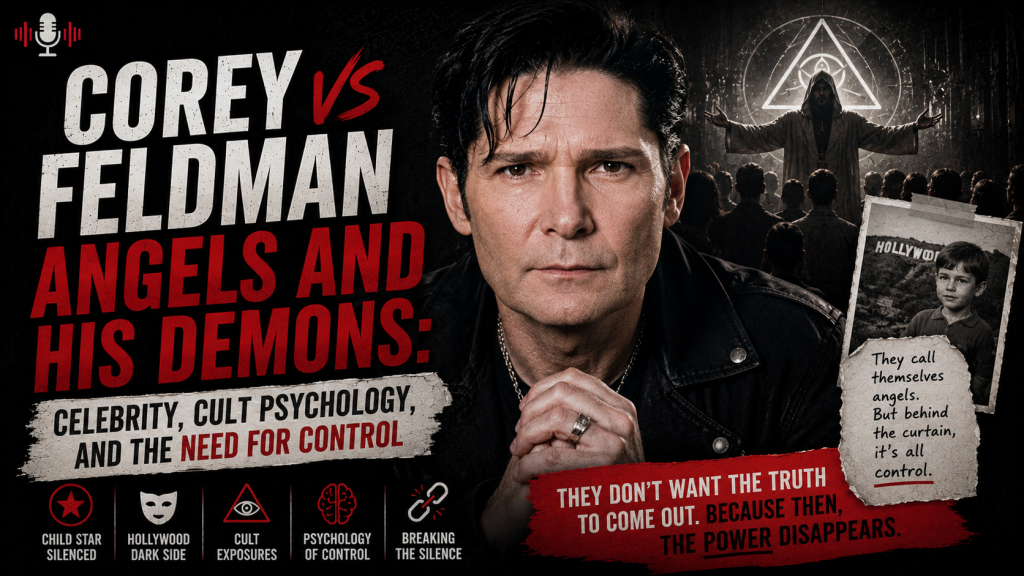
What happens when childhood fame, unresolved trauma, and a desperate need for validation collide?
That question sits at the center of the documentary Corey Feldman vs. The World and the latest episode of PodCandy: Cults, Crime and Killers.
In this episode, Stacey, Dori, and Dr. John Mayer examine the strange and often disturbing world surrounding Corey Feldman, his entourage known as “Corey’s Angels,” and the psychological patterns that emerge when celebrity status, personal trauma, and control intersect. The discussion explores allegations of cult-like dynamics, emotional dependency, manipulation, and the psychological consequences of living inside a self-created reality.
Who Is Corey Feldman?
For many people, Corey Feldman is a symbol of 1980s Hollywood.
He starred in iconic films including The Goonies, Stand By Me, and The Lost Boys. Alongside Corey Haim, he became one-half of “The Two Coreys,” one of Hollywood’s most recognizable young acting duos. Feldman has also spoken publicly about abuse within the entertainment industry and the long-term impact childhood fame had on his life.
But the documentary focuses on a very different chapter of his life.
Rather than revisiting childhood stardom, it follows Feldman during a turbulent period involving his music career, public criticism, and the controversial group known as “Corey’s Angels.”
What Was Corey’s Angels?
One of the most controversial aspects of the documentary involves Feldman’s group known as “Corey’s Angels.”
The group consisted of young women who performed, traveled, and worked within Feldman’s entertainment orbit. Critics and former participants have described strict expectations, unusual power dynamics, and concerns about control. Public discussions surrounding the group have raised questions about dependency, image management, and whether celebrity influence can create cult-like environments.
The documentary does not simply ask whether the group was unusual.
It asks a deeper question:
At what point does loyalty become control?
The Psychology of Cult-Like Celebrity Environments
Dr. John Mayer explains that cult psychology is not always about religion or isolated compounds.
Many cult-like systems develop around power, influence, identity, and emotional dependency.
Common warning signs include:
- A charismatic central figure
- Excessive loyalty demands
- Isolation from outside criticism
- Control over personal decisions
- Us-versus-them thinking
- Dependence on group approval
These patterns can emerge in organizations, self-help movements, social groups, and sometimes even celebrity circles.
According to Dr. Mayer, the most dangerous aspect of these environments is that they rarely appear harmful at first. Most begin with belonging, opportunity, and emotional connection.
This is a topic explored further in our article on The Psychology of Cult Leaders and Manipulation Techniques.
Childhood Trauma and the Search for Control
One of the most fascinating discussions in the episode centers on trauma.
Many psychologists recognize that childhood trauma can create lifelong struggles involving trust, identity, fear, and self-worth.
Dr. Mayer explains that individuals who experience instability early in life sometimes develop an intense need to control their environment as adults.
That does not excuse harmful behavior.
But it may help explain why some people become deeply invested in controlling narratives, relationships, and the people around them.
The documentary repeatedly raises questions about whether unresolved trauma may have influenced Feldman’s worldview and decision-making.
Why People Stay in Controlling Environments
A question often asked about cults and coercive groups is simple:
Why don’t people just leave?
The answer is more complicated than most people realize.
Dr. Mayer explains that emotional dependency, fear of losing belonging, financial concerns, and psychological manipulation can make leaving extremely difficult.
Former members of groups associated with “Corey’s Angels” have described experiences involving control, body-image pressure, and emotional influence. These claims have fueled ongoing public debate about the nature of the group’s internal dynamics.
This same psychological pattern appears repeatedly in:
- Cults
- Abusive relationships
- High-control organizations
- Manipulative communities
The Messiah Complex and Self-Created Reality
One of the most striking moments discussed in the podcast is Dr. Mayer’s comparison between certain behavioral patterns seen in the documentary and broader examples of charismatic leadership.
The episode explores:
- Self-mythologizing
- Victim narratives
- Persecution beliefs
- The need for recognition
- The desire to be viewed as extraordinary
These traits do not automatically make someone a cult leader.
However, when combined with power, influence, and a loyal following, they can create environments where criticism becomes the enemy and loyalty becomes the highest value.
According to the documentary’s coverage, concerns about paranoia, conspiratorial thinking, and controlling narratives became increasingly visible during Feldman’s touring years.
Why This Story Matters
The story of Corey Feldman is about more than one celebrity.
It highlights larger questions about:
- Fame
- Trauma
- Power
- Influence
- Manipulation
- Human vulnerability
Dr. Mayer explains that many people assume they would recognize manipulation immediately.
The reality is that influence often begins with trust, opportunity, belonging, and admiration.
That is why understanding cult psychology and coercive control is so important.
Frequently Asked Questions
Is Corey Feldman vs. The World a cult documentary?
The documentary explores allegations and concerns about cult-like dynamics surrounding Corey Feldman and his entourage, Corey’s Angels. It raises questions about power, control, loyalty, and influence but leaves viewers to draw their own conclusions.
What is Corey’s Angels?
Corey’s Angels was a group of women associated with Corey Feldman’s music projects and public appearances. Over the years, it became the subject of public controversy and criticism regarding control and power dynamics.
Why do cult-like groups form around celebrities?
Psychologists suggest that fame, charisma, emotional influence, and the human desire for belonging can sometimes create environments where followers become unusually loyal to a central figure.
What does Dr. John Mayer say about this case?
Dr. Mayer believes the documentary provides an opportunity to examine how trauma, identity, control, and psychological dependency can influence both leaders and followers within high-control environments.
Final Thoughts
The PodCandy episode Corey Feldman vs Angels and His Demons is not simply about a celebrity.
It is about what happens when fame, trauma, power, and psychological influence become intertwined.
By examining cult psychology, emotional dependency, and the human need for belonging, the episode offers a deeper understanding of how seemingly harmless communities can evolve into something far more complicated.
Listen the full PodCandy episode here:
For more analysis on cult psychology, manipulation, serial killers, and criminal behavior, explore additional articles on PodCandy: Cults, Crime and Killers.