


Imagine waking up on a family vacation and realizing someone you love has vanished.
No goodbye. No clear explanation. No confirmed witness who can tell you exactly what happened. Just an empty space where your daughter, sister, or friend was supposed to be.
That is the nightmare at the center of Amy Lynn Bradley’s disappearance.
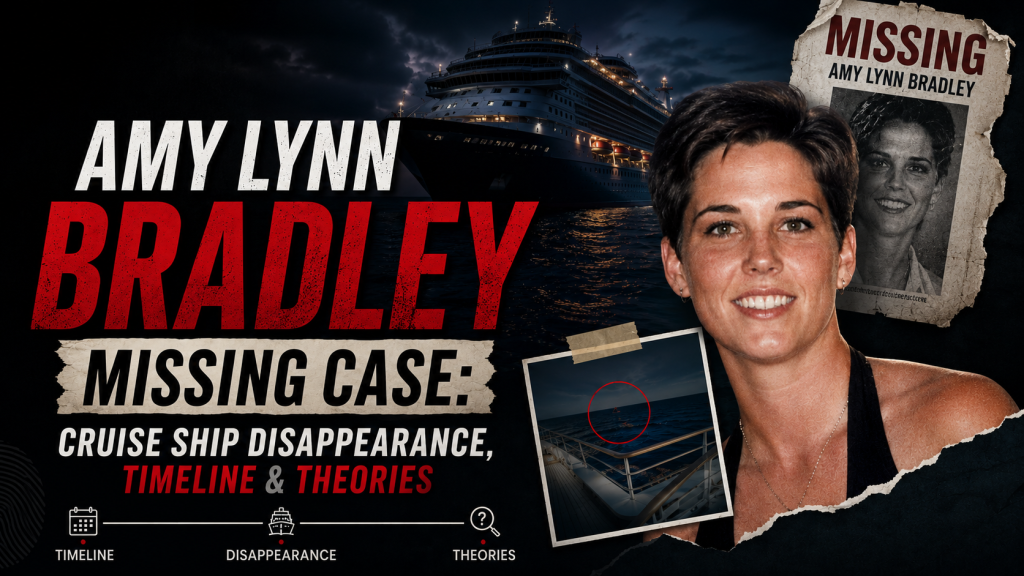
Amy Lynn Bradley was only 23 years old when she disappeared from Royal Caribbean International’s Rhapsody of the Seas during a Caribbean cruise on March 24, 1998. She had been traveling with her family, and what began as a peaceful vacation quickly became one of the most disturbing missing-person cases in modern true crime.
According to the FBI, the ship departed San Juan, Puerto Rico, on March 21, 1998, traveled to Aruba, and was heading toward Curaçao when Amy went missing during the early morning hours of Tuesday, March 24, 1998. Her case remains unresolved, and the FBI currently offers a reward of up to $100,000 for information leading to her recovery and to the identification, arrest, and conviction of whoever may be responsible.
For the public, Amy’s case feels like a mystery filled with questions, theories, and possible sightings. For her family, it is something far more painful: a wound that has remained open for decades.
At PodCandy, cases like this are not treated as entertainment alone. They are stories of real people, real families, and real psychological damage. PodCandy describes crime as “a window into the human mind” and highlights Dr. John Mayer’s role in exploring motives and mindsets behind disturbing cases.
Through that lens, Amy Lynn Bradley’s disappearance is not just a cruise ship mystery. It is a story about uncertainty, fear, family trauma, investigative gaps, and the human need for answers.
Listen to the PodCandy Podcast Episode on Amy Lynn Bradley
Before moving deeper into Amy Lynn Bradley’s timeline, theories, and unanswered questions, you can also listen to the full PodCandy podcast episode on this case.
In this episode, PodCandy explores Amy’s disappearance not only as a true crime mystery, but as a psychological case study in uncertainty, family trauma, missing-person investigations, and the emotional damage caused when a loved one vanishes without answers.
Dr. John Mayer’s insight adds another layer to the conversation. Cases like Amy’s are not only about evidence, timelines, and theories. They are also about the human mind trying to survive the unbearable unknown.
Amy Lynn Bradley’s case remains unresolved, but conversations like this help keep her name alive, encourage responsible awareness, and remind listeners that behind every true crime story is a real person and a real family still searching for answers.
Who Was Amy Lynn Bradley?
Before Amy became the subject of theories, documentaries, and online speculation, she was a daughter, sister, friend, and young woman with a future.
The FBI lists Amy Lynn Bradley as born on May 12, 1974, in Petersburg, Virginia. At the time of her disappearance, she was described as 5 feet 6 inches tall and 120 pounds, with short brown hair and green eyes. She also had several identifying tattoos, including a Tasmanian Devil spinning a basketball on her shoulder, a sun on her lower back, a Chinese symbol on her right ankle, and a gecko lizard on her navel. She also had a navel ring.
Those details matter.
In true crime, victims can easily become symbols of mystery. Their names become search terms. Their faces become documentary thumbnails. Their lives become timelines. But Amy was not just “the missing woman from the cruise ship.” She was a real person with a life before the case became public.
A Dr. John Mayer-style psychological approach reminds us that ethical true crime begins with humanization. The victim must never disappear behind the mystery. If the story loses sight of the person, then the audience is no longer seeking truth; it is simply consuming pain.
Amy’s identity should remain central to the story. She was not only the subject of an investigation. She was someone loved, remembered, and still searched for.
The Cruise Before Amy Disappeared
Amy was traveling with her family aboard Royal Caribbean International’s Rhapsody of the Seas. The FBI states that the ship left San Juan, Puerto Rico, on Saturday, March 21, 1998. It traveled to Aruba, then departed Aruba on Monday, March 23, while heading toward Curaçao. During the early morning hours of Tuesday, March 24, Amy Lynn Bradley went missing. The ship later continued to Sint Maarten, St. Thomas, and returned to San Juan on March 28.
On paper, the timeline seems simple. A family boarded a cruise. The ship moved from one Caribbean stop to another. A young woman disappeared.
But emotionally and psychologically, nothing about this case is simple.
Cruise ships create a strange sense of safety. They feel contained. They feel organized. There are cabins, decks, restaurants, staff, security, schedules, and public spaces. But a ship is also a moving environment filled with strangers. People drink, dance, sleep, wander, disembark, and scatter. What feels controlled can become chaotic very quickly.
That is one reason Amy’s disappearance still disturbs people. She did not vanish from a dark alley or an isolated road. She disappeared from a vacation setting, surrounded by people, in a place where her family believed she was safe.
Dr. John Mayer’s psychological insight fits strongly here. People often expect danger to look obvious. But many real cases are frightening because danger is not obvious at first. Sometimes the most terrifying detail is not what is seen, but what is missing.
Amy Lynn Bradley Timeline
Amy’s case centers on a narrow and haunting early-morning window.
The FBI confirms that Amy disappeared during the early morning hours of March 24, 1998, while the ship was traveling from Aruba toward Curaçao.
Here is the basic timeline:
| Date | Event |
| March 21, 1998 | Rhapsody of the Seas departed San Juan, Puerto Rico |
| March 23, 1998 | The ship departed Aruba |
| Early March 24, 1998 | Amy Lynn Bradley went missing |
| March 24, 1998 | The ship traveled toward Curaçao |
| March 28, 1998 | The ship returned to San Juan, Puerto Rico |
In simple terms: Amy was there, and then she was gone.
That sentence is why this case has stayed in public memory for decades. There is no clean ending. No confirmed explanation. No final scene that tells the family or investigators what happened.
From a psychological point of view, narrow timelines create obsession. Families replay minutes. Investigators study movements. Audiences search for hidden meaning. What was normal? What was strange? Who saw her? Who should have acted sooner?
This is not ordinary curiosity. It is the mind trying to turn trauma into a sequence it can understand.
PodCandy’s crime analysis emphasizes that understanding disturbing events often requires looking beyond the surface and exploring the worldview, motive, circumstance, and emotion behind human behavior. In Amy’s case, that means looking not only at the timeline, but also at the fear, confusion, panic, and uncertainty surrounding those early hours.
Why the First Few Hours Mattered
In any missing-person case, the first few hours can shape everything.
Witness memories are fresh. Physical evidence may still exist. Security decisions matter. People who saw something may still be nearby. But Amy’s case involved a cruise ship, and a cruise ship is not a fixed crime scene.
It moves.
It docks.
Passengers leave.
Crew members continue working.
Possible witnesses scatter into different countries, airports, hotels, and homes.
This is one of the most painful parts of the Amy Lynn Bradley case. A disappearance on land is already difficult. A disappearance at sea adds more layers: jurisdiction, ship movement, passenger movement, crew schedules, and the difficulty of preserving a scene that was never designed to become a crime scene.
For a family, that kind of uncertainty is devastating. The mind immediately begins to imagine every possible path. Did she fall? Did she leave? Was she taken? Did someone see her? Was the answer still on the ship?
Dr. Mayer’s PodCandy-style perspective helps explain why such moments become lifelong emotional anchors. In unresolved disappearances, families do not only remember the event. They remember the decisions around the event. Every delay, every missed chance, every unanswered question can become part of the trauma.
Theories About Amy Lynn Bradley’s Disappearance
Amy Lynn Bradley’s disappearance has produced many theories over the years. But responsible true crime storytelling must separate confirmed facts from speculation.
No theory has been officially proven. Amy has not been found. The FBI continues to list her case publicly and asks anyone with information to contact a local FBI office or the nearest American Embassy or Consulate.
Theory 1: Accident or Overboard
One theory is that Amy may have accidentally gone overboard. This theory is often discussed because she disappeared from a cruise ship in the early morning hours.
However, Amy’s body was never recovered, and the case remains unresolved. That means the overboard theory should be treated as a possibility, not a conclusion.
Theory 2: Voluntary Disappearance
Another theory suggests Amy may have left voluntarily. But this explanation has always been difficult for many people to accept, especially because she was traveling with her family and disappeared without clear evidence of planning a new life.
There is no confirmed evidence proving that Amy chose to vanish.
Theory 3: Sex Trafficking
One of the most discussed theories in Amy’s case is the possibility of sex trafficking, mainly because of the mysterious circumstances surrounding her disappearance and the reported sightings over the years.
However, this theory should be approached carefully. Reported sightings are not verified evidence, and no public proof has confirmed that Amy was trafficked or held against her will.
Dr. John Mayer from PodCandy: Cults, Crime and Killers explains that unresolved disappearances often lead to theories that feel both frightening and believable. While sex trafficking remains one possible explanation, the case has never been conclusively solved.
Theory 4: Possible Sightings
Possible sightings keep Amy’s name alive, but they also create emotional whiplash for the family.
Every new account can bring hope.
Every unconfirmed lead can reopen grief.
Every false possibility can hurt all over again.
Dr. Mayer’s psychological lens is especially useful here. When facts are missing, the human brain tries to fill the silence. That does not mean every theory is true. It means uncertainty is painful, and people naturally search for a complete story.
Why Amy’s Case Feels So Disturbing
Amy Lynn Bradley’s case is disturbing because it combines several fears at once.
She was young.
She was with family.
She disappeared from a crowded cruise ship.
The timeline was narrow.
The setting was supposed to be safe.
The case still has no confirmed answer.
Vacations are supposed to feel like escape. A cruise is marketed as comfort, pleasure, and safety. When someone disappears in that environment, it violates a basic psychological expectation: that safe places are actually safe.
That is why this case continues to haunt true crime audiences. It forces people to ask uncomfortable questions. How can someone vanish from a cruise ship? How can a family vacation turn into a lifelong search? How can a case have so many theories and still no answer?
Dr. Mayer’s insight helps us understand the deeper fear. Amy’s case is not only frightening because she disappeared. It is frightening because she disappeared from a place where disappearance felt impossible.
The Family’s Search for Answers
The most painful part of Amy’s story is not only the mystery. It is the long-term suffering carried by her family.
Families of missing people often live with a form of grief known as ambiguous loss. Researcher Pauline Boss developed the concept, and Missing People explains that in relation to missing persons, ambiguous loss can mean a loved one is physically absent yet psychologically present.
Amy’s family has had to live with the same question for decades:
What happened to Amy?
That question does not stay in the past. It returns with every anniversary, every documentary, every tip, every possible sighting, every news article, and every unanswered lead.
Through a PodCandy psychology lens, Amy’s disappearance becomes more than an investigation. It becomes a study in how uncertainty affects the human mind. Hope and fear live together. Grief and possibility live together. The family is forced to prepare for the worst while still hoping for the best.
That is not closure.
That is psychological limbo.
Amy Bradley Is Missing on Netflix
Public interest in Amy’s case increased again when Netflix released Amy Bradley Is Missing, a three-episode true-crime documentary series in 2025. Netflix describes the series as an investigation into the 1998 disappearance of a 23-year-old woman from a Caribbean cruise and her family’s tireless search for answers.
The documentary brought Amy’s story to a new generation of viewers. It also renewed discussion about the timeline, possible sightings, family concerns, and the emotional toll of the case.
Documentaries can help unresolved cases. They can bring attention, generate tips, and remind the public that a missing person is still missing. But they also carry responsibility.
When a family has spent decades without answers, every retelling can reopen the wound. Every theory can become another burden. Every careless claim can spread misinformation.
A Dr. John Mayer-style insight is important here: ethical true crime should never turn suffering into spectacle. The purpose should be awareness, truth, prevention, and compassion.
Why Missing-Person Cases Capture the Public Mind
Unresolved missing-person cases affect the public differently than solved crimes.
A solved case has an ending. A missing-person case often does not.
There may be no confession.
No body.
No trial.
No confirmed suspect.
No final chapter.
That absence creates psychological tension. People keep reading because they want the story to make sense. They study timelines, debate theories, compare witness statements, and search for overlooked details.
In Amy Lynn Bradley’s case, the mystery feels especially intense because the setting seems contained. The question sounds simple: how can someone disappear from a cruise ship?
But the answer has never been simple.
This is where PodCandy’s psychological approach becomes valuable. Human beings are pattern-seeking. When a story has missing pieces, the mind continues working on it. That is why unresolved cases stay alive in public memory. People are not only looking for facts. They are looking for emotional completion.
What We Know and What We Still Do Not Know
What we know is that Amy Lynn Bradley disappeared on March 24, 1998, from Royal Caribbean International’s Rhapsody of the Seas. She was 23 years old, traveling with her family, and the ship was moving from Aruba toward Curaçao. The FBI still lists Amy as missing and offers a reward of up to $100,000 for qualifying information.
What we do not know is how she disappeared.
We do not know whether Amy left the ship alive.
We do not know whether she went overboard.
We do not know whether someone took her.
We do not know whether any reported sighting was truly Amy.
We do not know who, if anyone, was responsible.
That gap between known and unknown is the heart of the case.
And that gap is exactly what keeps families, investigators, and true crime audiences returning to Amy’s story.
The Ethics of Telling Amy Lynn Bradley’s Story
Amy’s case should be covered carefully.
It is acceptable to discuss theories.
It is not acceptable to present theories as proven facts.
It is acceptable to mention reported sightings.
It is not acceptable to treat unconfirmed accounts as verified evidence.
It is acceptable to ask questions.
It is not acceptable to accuse people without official confirmation.
True crime audiences often want answers, but real cases require restraint. The stronger approach is not sensationalism. It is disciplined curiosity.
Amy’s story should be told in a way that keeps her humanity at the center.
Dr. Mayer’s PodCandy-style insight fits powerfully here: when curiosity loses compassion, true crime becomes harmful. The goal should not be to turn pain into entertainment. The goal should be to remember the victim, respect the family, and keep attention on truth.
Where the Case Stands Today
Amy Lynn Bradley remains missing.
The FBI asks anyone with information about Amy’s disappearance to contact a local FBI office or the nearest American Embassy or Consulate. The agency continues to list a reward of up to $100,000 for information leading to Amy’s recovery and to the identification, arrest, and conviction of the person or people responsible for her disappearance.
Her case remains unresolved, but unresolved does not mean forgotten.
Amy’s name continues to appear in FBI records, true crime discussions, documentaries, and the memories of people who still hope the right person will come forward.
Final Thoughts: A Mystery, A Family, A Wound That Never Closed
Amy Lynn Bradley’s disappearance is not only a cruise ship mystery.
It is a story about uncertainty.
It is a story about family trauma.
It is a story about the limits of safety.
It is a story about the human need for answers.
For the public, Amy’s case raises questions. For her family, it changed everything.
That is why this story must be told with care. Behind every theory is a real woman. Behind every timeline is a real family. Behind every possible sighting is another wave of hope and fear.
Dr. John Mayer’s forensic psychology perspective helps us understand why cases like Amy’s stay with us. The mind struggles with unfinished stories. Families struggle with unfinished grief. Investigators struggle with missing evidence. Audiences struggle with the same haunting question that has remained since March 24, 1998:
What happened to Amy Lynn Bradley?
Until that answer comes, her story remains open.
Not as entertainment.
As memory.
As warning.
As hope.