


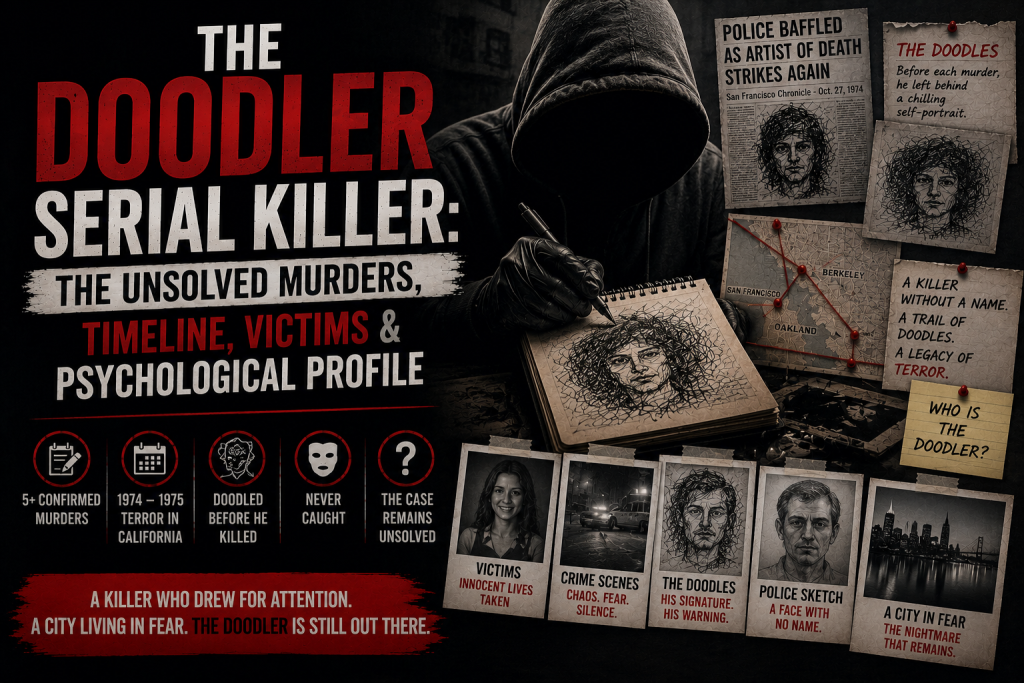
Imagine meeting someone in a crowded bar. He seems friendly, easy to talk to, and even sketches your portrait on a napkin while the conversation flows naturally. Nothing about him appears threatening. You say goodbye, believing you’ve met an interesting stranger.
Hours later, someone is found murdered.
That chilling pattern lies at the heart of one of America’s most disturbing unsolved serial killer cases. Between 1974 and 1975, a mysterious man believed to have targeted gay men across San Francisco allegedly murdered at least five people and may have killed as many as fourteen. Because he reportedly drew sketches of people before or during conversations, investigators and the media gave him a haunting nickname: The Doodler.
Despite decades of investigation, no one has ever been convicted of these crimes. Although detectives reportedly developed a strong suspect, the case ultimately stalled, leaving victims’ families without answers and allowing one of California’s most notorious serial killers to remain unidentified in the public eye.
At PodCandy Podcast, true crime is explored through the lens of both investigation and psychology. Rather than focusing only on shocking crimes, Dr. John Mayer examines offender behavior, criminal motives, victimology, and the lasting psychological impact violent crimes leave on families and communities.
The Doodler case remains one of the clearest examples of how fear, prejudice, limited forensic technology, and missing evidence can prevent justice from being served.
Who Was The Doodler?
Unlike infamous serial killers whose identities became household names, The Doodler has never been publicly identified or convicted.
Authorities believe the suspect was a young African American man who frequented bars, restaurants, and nightlife popular within San Francisco’s gay community during the mid-1970s. According to investigators, he often approached strangers, started casual conversations, and sometimes sketched quick portraits while talking.
That harmless artistic habit eventually became the defining feature of the investigation.
Witnesses described someone who appeared intelligent, polite, and approachable. Instead of using intimidation, he reportedly relied on conversation and trust before the attacks occurred.
From a forensic psychology perspective, this behavior reflects a common characteristic of organized offenders. As Dr. John Mayer explains on PodCandy Podcast, many violent criminals first establish familiarity before committing violence. Trust often becomes the first tool of manipulation.
San Francisco During the 1970s
Understanding The Doodler requires understanding San Francisco itself.
During the 1970s, the city became an important center for LGBTQ+ culture and community. Neighborhoods such as Castro were experiencing enormous social change, yet prejudice and discrimination remained widespread throughout society.
Many gay men were not openly out.
Some feared losing their jobs.
Others feared rejection by family members or public exposure.
These social realities had a significant impact on the investigation. Several individuals reportedly survived encounters with the suspected killer, but some were unwilling to testify publicly because appearing in court might reveal their sexual orientation.
This created one of the greatest challenges investigators faced.
As Dr. John Mayer often notes, criminal investigations are influenced not only by evidence but also by the society in which they occur. Fear can affect witnesses just as much as offenders.
The Doodler Murders Timeline
The attacks occurred over approximately eighteen months between 1974 and 1975.
Although investigators believe there may have been additional victims, the generally accepted timeline includes:
| Year | Event |
| January 1974 | Authorities believe the first attacks began. |
| 1974 | Several victims were discovered in parks and coastal areas around San Francisco. |
| Early 1975 | Additional murders displayed similar patterns. |
| Mid-1975 | Police connected multiple killings to a single offender. |
| Late 1975 | Detectives reportedly identified a primary suspect. |
| Investigation Stalled | Key witnesses declined to testify publicly. |
| Present Day | The case officially remains unsolved. |
Each new murder increased fear throughout San Francisco.
Each victim strengthened the belief that detectives were dealing with a serial killer.
Unfortunately, proving the suspect’s guilt proved far more difficult than identifying him.
The Victims
Authorities officially connect at least five murders to The Doodler, although investigators have suggested the true number could be much higher.
Most victims shared several characteristics.
They were adult men.
Many had visited bars before disappearing.
Several were later discovered in isolated outdoor locations after apparently leaving with someone they had recently met.
These similarities helped investigators identify behavioral patterns and link multiple murders together.
At PodCandy Podcast, Dr. John Mayer emphasizes that victims should always remain at the center of every true crime story. Understanding offender behavior is important, but never at the expense of remembering the lives that were lost.
How The Doodler Chose His Victims
Serial offenders rarely choose victims completely at random.
Investigators believe The Doodler searched for opportunities rather than specific individuals.
He reportedly spent time in nightlife areas, approached strangers naturally, and gained their confidence through conversation.
Rather than appearing dangerous, he appeared friendly.
Rather than threatening victims, he earned their trust.
Behavioral experts often describe this as social manipulation a strategy that allows offenders to lower a victim’s sense of danger before committing violence.
According to Dr. John Mayer, manipulation often begins long before a crime occurs. Predators frequently appear ordinary, making them far more difficult for potential victims to recognize.
The Police Investigation
As additional murders occurred, detectives noticed clear similarities.
The victims had suffered multiple stab wounds.
Several had recently visited similar locations.
The crimes followed recognizable behavioral patterns.
Eventually, investigators believed they had identified a likely suspect.
However, identifying someone and successfully prosecuting them are two different challenges.
Without sufficient evidence and witness testimony, prosecutors believed they could not prove guilt beyond a reasonable doubt.
That obstacle ultimately prevented the case from moving forward.
Why Was The Case Never Solved?
Many people assume unsolved murders remain mysteries because police never identify a suspect.
The Doodler case demonstrates a different reality.
Investigators reportedly believed they knew who the killer might be.
The problem was evidence.
Successful criminal prosecutions require physical evidence, reliable witnesses, and corroborating testimony.
Several individuals who reportedly survived encounters with the suspect declined to testify publicly because of concerns surrounding their privacy and the social climate of the 1970s.
Without enough evidence, prosecutors could not move forward.
The investigation became trapped between suspicion and proof.
The Psychological Profile of The Doodler
Although no official psychological evaluation exists, behavioral analysis offers insight into the offender’s actions.
Organized Behavior
The attacks followed recognizable patterns.
Victims shared similar characteristics.
Locations appeared carefully selected.
These behaviors suggest planning rather than impulsive violence.
Ability to Build Trust
Perhaps the most striking characteristic was the suspect’s ability to appear harmless.
Conversation became his tool.
Friendliness became his disguise.
Many organized offenders rely on social skills rather than immediate force.
Control
Knife attacks require close physical contact between offender and victim.
Behavioral experts often study this type of violence because it may indicate emotional intensity, domination, or a desire for personal control.
However, psychology cannot determine motive with certainty.
As Dr. John Mayer frequently explains on PodCandy Podcast, behavioral science should support evidence not replace it.
Could Modern Forensics Solve The Case?
The original investigation took place before DNA profiling became available.
Today, detectives have access to technologies unimaginable during the 1970s.
DNA testing.
Fingerprint databases.
Genetic genealogy.
Advanced forensic laboratories.
These scientific advances have solved countless cold cases across the United States.
If usable evidence still exists, modern forensic techniques may provide new investigative leads.
Although no one knows whether The Doodler case will ever be solved, advances in forensic science continue to offer hope.
Why The Doodler Still Fascinates True Crime Audiences
Nearly fifty years later, The Doodler remains one of America’s most discussed unsolved serial killers.
Part of that fascination comes from the unanswered questions.
Who was he?
Why did he stop?
Was the suspect investigators identified truly responsible?
Could additional victims exist?
Psychologically, unfinished stories continue to occupy our attention because the human mind naturally seeks closure.
This is one reason cold cases continue generating public interest decades after the crimes occurred.
Final Thoughts
The Doodler is more than an unsolved serial killer case.
It is a story about victims whose lives ended too soon.
It is a story about investigators who came close to solving a case but lacked the evidence needed for prosecution.
It is a story about how prejudice and fear affected justice during the 1970s.
Most importantly, it reminds us that behind every famous criminal investigation are real people whose families continue living without answers.
At PodCandy Podcast, cases like The Doodler are explored responsibly through evidence, psychology, and compassion. With insights from Dr. John Mayer, listeners are encouraged to think beyond sensational headlines and better understand the behavioral patterns that shape violent crime.
While The Doodler’s identity remains unknown, the lessons from this investigation continue to influence modern criminal profiling, forensic psychology, and cold case investigations.
Justice may have been delayed.
But as history has shown with many cold cases, it is never impossible.
Frequently Asked Questions
Who was The Doodler?
The Doodler is the nickname given to an unidentified serial killer believed to have murdered at least five men in San Francisco between 1974 and 1975.
Why was he called The Doodler?
Investigators believe the suspect often sketched portraits of people before or during conversations, leading to the nickname “The Doodler.”
How many victims did The Doodler have?
Authorities officially connect at least five murders to the case, although some investigators believe there may have been as many as fourteen victims.
Why was the case never solved?
The investigation reportedly stalled because prosecutors lacked sufficient evidence and key witnesses declined to testify publicly.
Could modern DNA technology solve the case?
Possibly. Modern forensic science has solved many decades-old cold cases, giving investigators hope that preserved evidence could one day identify the killer.
Where can I learn more about cases like this?
You can explore more true crime stories, criminal psychology, and behavioral analysis through PodCandy Podcast, where Dr. John Mayer examines the people, investigations, and psychological factors behind some of history’s most fascinating criminal cases.