


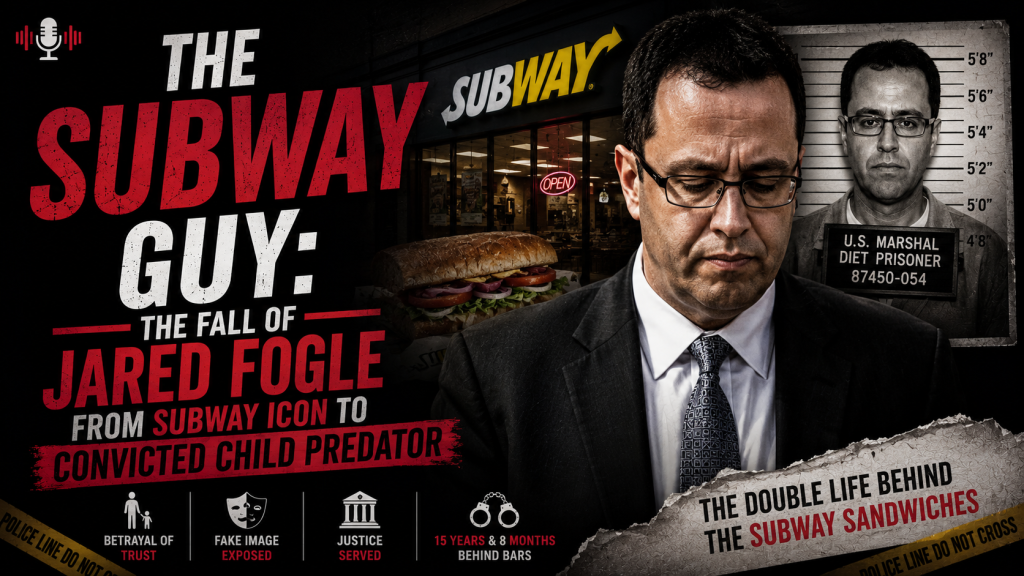
Imagine a man trusted by families, schools, television audiences, and millions of everyday people.
A smiling face. A weight-loss success story. A fast-food spokesperson. A man who looked harmless because the public had been taught to see him that way.
That was the public image of Jared Fogle, better known to many as “The Subway Guy.”
For years, Fogle was associated with transformation, discipline, and the familiar comfort of a global food brand. He was not presented as a frightening public figure. He was marketed as ordinary, relatable, and safe.
But behind that public image was a much darker reality.
In 2015, federal authorities charged Jared S. Fogle with crimes involving child sexual abuse material and unlawful commercial sex acts with minors. He later received a federal prison sentence of 188 months, or 15 and a half years, along with lifetime supervised release and restitution obligations to victims.
This case shocked the public not only because of the crimes, but because of the contrast. The man people thought they knew was not the man revealed through the federal investigation.
At PodCandy, true crime is not just about shock value. It is about understanding the human mind, the masks people wear, and the systems that sometimes fail to see danger until harm has already been done. PodCandy describes crime as “a window into the human mind” and highlights insight from forensic psychology expert Dr. John Mayer.
Through that lens, the Jared Fogle case is not just a celebrity scandal. It is a disturbing study of image, access, secrecy, manipulation, and the danger of confusing familiarity with safety.
Who Was Jared Fogle?
Jared Fogle became famous as the public face of Subway’s advertising campaigns. To many people, he was simply “Jared from Subway,” the ordinary man who became widely known through a weight-loss story connected to the sandwich chain.
That story made him marketable because it felt personal. He was not framed as a glamorous celebrity or an untouchable public figure. He looked like someone people might know. That relatability became part of his power.
The public saw a friendly spokesperson. He appeared in media and brand campaigns, and his image became attached to health, discipline, and everyday transformation. For many people, Fogle became part of American pop culture: commercials, sandwiches, weight loss, and brand trust.
That is what makes the case so disturbing.
Predators do not always appear threatening. Sometimes they appear familiar. Sometimes they are invited into spaces because their public image has already done the work of making people comfortable.
A Dr. John Mayer-style psychological reading of this case begins with that mask. Dangerous people do not always hide by disappearing. Some hide by becoming visible in a way that feels safe.
The Public Image: Health, Fame, and Trust
Jared Fogle’s public power came from the idea that he was ordinary.
His image was not built around glamour. It was built around self-improvement. That made people trust him differently. He was framed as someone who changed his life, and that story gave him emotional credibility.
This matters because public image can become a shield.
When a person is repeatedly shown as harmless, helpful, funny, or inspiring, people become less likely to question them. The brain prefers simple categories. Good people look good. Bad people look bad. Safe people feel safe. Dangerous people seem obvious.
But real criminal behavior often breaks that illusion.
The Jared Fogle case is disturbing because it shows how public trust can be manipulated. His image created comfort, and comfort can lower suspicion. People may not look closely at someone they have already decided is safe.
That is one of the most important psychological lessons of this case: trust should never be based on image alone.
The Criminal Case Against Jared Fogle
In August 2015, the FBI announced that Jared S. Fogle had been formally charged with distributing and receiving child pornography, conspiring to do so, and repeatedly traveling to engage in commercial sex acts with underage minors. The FBI also stated that Fogle had notified the U.S. District Court that he would plead guilty to all charges.
For victim-centered language, many advocates and writers now use the term child sexual abuse material instead of “child pornography.” Legal sources may still use the older legal term, but “child sexual abuse material” more accurately recognizes that the images and videos document the abuse and exploitation of children.
Federal authorities said the case was investigated by state, local, and federal agencies, including the Indiana State Police, Indianapolis Metropolitan Police Department, FBI, and Indiana Internet Crimes Against Children Task Force.
In November 2015, the U.S. Department of Justice announced that Fogle had been sentenced to 188 months in federal prison. The DOJ also stated that he was required to serve lifetime supervised release, pay a $175,000 fine, forfeit $50,000 in assets, and pay $1.4 million in restitution to 14 victims.
The facts are severe, but they should not be handled for shock alone. This was not just the downfall of a public figure. It was a child exploitation case with real victims and lasting harm.
Russell Taylor and the Hidden Network
Jared Fogle’s case also involved Russell Taylor, a man connected to Fogle’s charitable foundation. Taylor became a central figure in the investigation.
In December 2015, the FBI reported that Russell Taylor was sentenced to 27 years in federal prison after his conviction on 12 counts of sexual exploitation of a child and one count of distribution of child pornography. The FBI said investigators found material Taylor had produced by secretly filming minor children.
A later DOJ update in 2022 described a broader years-long conspiracy involving Taylor, Angela Baldwin, and Jared Fogle. According to the DOJ, Taylor and Baldwin worked with others, including Fogle, to produce, possess, and distribute child sexual abuse material between 2011 and 2015. The DOJ stated that Taylor was sentenced to 324 months in federal prison and Baldwin was sentenced to 400 months.
This part of the case matters because predatory behavior is often supported by secrecy, access, and reinforcement. Offenders may validate one another, exchange illegal material, or normalize behavior that should trigger immediate reporting.
Dr. Mayer’s forensic psychology lens helps explain the danger: when deviant behavior is hidden inside trusted relationships or institutions, the risk can grow quietly. That is why early reporting, strong boundaries, and accountability systems are essential.
Why This Case Shocked the Public
The Jared Fogle case shocked people because it destroyed a familiar public story.
The public thought they knew him. They had seen the commercials. They had heard the weight-loss story. They associated him with a family-friendly brand. They saw him as safe because his image had been repeated for years.
Then federal authorities revealed something completely different.
This kind of betrayal creates psychological discomfort. People do not only feel disgusted by the crime. They feel fooled. They wonder how they missed it. They question whether other familiar public figures could also be hiding dangerous behavior.
That is why the case still carries cultural weight. It is not only about Jared Fogle. It is about the fear that an image can lie.
A Dr. John Mayer-style insight would frame this as a collapse of perceived safety. The public image said one thing. The criminal reality revealed another. That gap is what makes the story so unsettling.
The Psychology of the Mask
One of the most disturbing parts of the Jared Fogle case is the mask.
A mask is not always a disguise in the obvious sense. Sometimes it is a carefully built public role. A person may perform normalcy so consistently that others stop asking deeper questions.
In psychology and criminal behavior analysis, this relates to compartmentalization: the ability to separate one part of life from another. A person can maintain a public identity while hiding private behavior. They can smile in public while causing harm in secret.
That split is deeply dangerous.
The public self looked trustworthy. The private conduct revealed in federal court showed predatory behavior. The brand image suggested safety. The legal record showed harm.
This is why the case should be studied beyond the headlines. Jared Fogle’s crimes were not shocking because he looked like a cartoon villain. They were shocking because he did not.
Predators often benefit from normalcy. They may use friendliness, charity, professional success, humor, or social status to lower suspicion. People around them may think, “He could never do that,” because they confuse personality with proof.
That is how masks work.
Victims Must Stay at the Center
The greatest mistake in covering this case would be making Jared Fogle the star of the story.
His fame explains why the case received attention, but his fame is not the heart of the case. The heart of the case is the harm done to children.
The DOJ stated that Fogle agreed to pay $1.4 million in restitution to 14 victims, with the funds intended to support counseling and treatment related to the effects of the crimes.
That detail matters because exploitation does not end when an offender is arrested. For victims, the damage can continue emotionally, psychologically, socially, and developmentally. Child sexual abuse material also creates repeated harm because the existence and circulation of the material can retraumatize victims long after the original abuse.
Responsible true crime should not use cases like this only for outrage. It should ask harder questions: Who was harmed? What systems failed? What warning signs were missed? How can children be better protected?
Dr. Mayer’s PodCandy-style perspective is important here. Ethical true crime does not turn victims into background details. It keeps the focus on harm, accountability, prevention, and truth.
Why People Miss Red Flags
People often ask how someone like Jared Fogle could hide behind a public image for so long.
The uncomfortable answer is that predators often benefit from social assumptions.
People may assume successful people are safer. They may assume famous people are being monitored. They may assume friendly people are harmless. They may assume charitable roles equal moral character. They may assume public trust is the same as private integrity.
But assumptions are not protection.
A familiar person can still be dangerous. A popular person can still be predatory. A person with a trusted public role can still exploit access and opportunity.
This is why institutions, families, schools, and communities need systems instead of blind trust. Background checks, reporting procedures, child protection policies, and strong boundaries are not signs of paranoia. They are safeguards.
The brain wants danger to look obvious. Real life teaches us that it often does not.
Brand Damage and Public Betrayal
Jared Fogle’s case also became a brand scandal because his identity was tied to Subway.
When a brand attaches itself to a human face, that person becomes more than a spokesperson. They become a symbol. For years, Fogle symbolized transformation and everyday relatability. That meant his crimes did not only damage his own reputation. They damaged the emotional trust people had placed in the image around him.
This is why spokesperson scandals can feel personal to the public. People feel like they were sold a story. In this case, the story was not just false; it hid something deeply harmful.
The lesson for brands is clear: public image requires accountability. A friendly face is not a safety system. A successful campaign is not a character reference. Trust must be supported by oversight, boundaries, and responsibility.
Watch the Podcast: The Subway Guy Monster Pedophile
To explore this case in more detail, watch the PodCandy podcast episode “The Subway Guy – Monster Pedophile.” In this episode, PodCandy examines Jared Fogle’s rise, the collapse of his public image, the criminal case, and the psychology behind hidden predatory behavior.
You can also add this short intro above the video:
In this PodCandy episode, we break down how Jared Fogle went from a trusted public spokesperson to a convicted child predator. We explore the psychology of the mask, the danger of public trust, and why victim-centered storytelling matters in child exploitation cases.
Legal Outcome and Current Status
Jared Fogle was sentenced in 2015 to 188 months in federal prison after being convicted of distributing and receiving child pornography and traveling in interstate commerce to engage in unlawful commercial sex acts with minors. The DOJ also stated that he must serve lifetime supervised release after his sentence.
The sentencing announcement also included financial penalties and restitution: a $175,000 fine, forfeiture of $50,000, and $1.4 million in restitution to 14 victims.
The legal outcome matters, but it does not undo the harm. A sentence can remove an offender from society. It can establish accountability. It can create a record. But it cannot erase what victims experienced.
That is why the story should not end with prison time. It should end with prevention.
Lessons from the Jared Fogle Case
The Jared Fogle case teaches several difficult lessons.
Public image is not proof of safety. Fame can make people less suspicious, not more protected. Predators may use ordinary roles, trusted identities, and social comfort as cover. Child protection cannot depend on whether someone “seems nice.”
The case also shows why victim-centered storytelling matters. The offender’s fame should never become more important than the victims’ pain. When true crime focuses only on the shocking fall of a public figure, it risks turning real harm into entertainment.
In the end, this case is not just about a man who fooled the public. It is about how easily people can mistake visibility for transparency. Being known by millions does not mean being truly known.
Dr. Mayer’s forensic psychology lens makes the warning sharper: harmful behavior often survives when people do not want to question the mask. The more familiar someone feels, the more courage it takes to look carefully.
Final Thoughts: The Danger Behind the Familiar Face
Jared Fogle’s story is not just the downfall of a celebrity spokesperson. It is a disturbing example of how public trust can be manipulated when image replaces accountability.
The man once known as “The Subway Guy” became a convicted child predator, and that contrast is what made the case so shocking. His public image was built around discipline, health, and everyday relatability, but the criminal investigation revealed a very different reality.
His case shows that predatory behavior does not always appear in obvious forms. Sometimes it hides behind popularity, familiarity, charity, and professional success. That is why communities, institutions, and families cannot rely on reputation alone when it comes to child safety.
At PodCandy, this case is not told to sensationalize evil. It is told to understand how harm can remain hidden, how victims can be overlooked, and why society must become more serious about protecting children.
True crime should do more than shock an audience. It should help people recognize warning signs, question false appearances, and understand the systems that allow abuse to continue.