


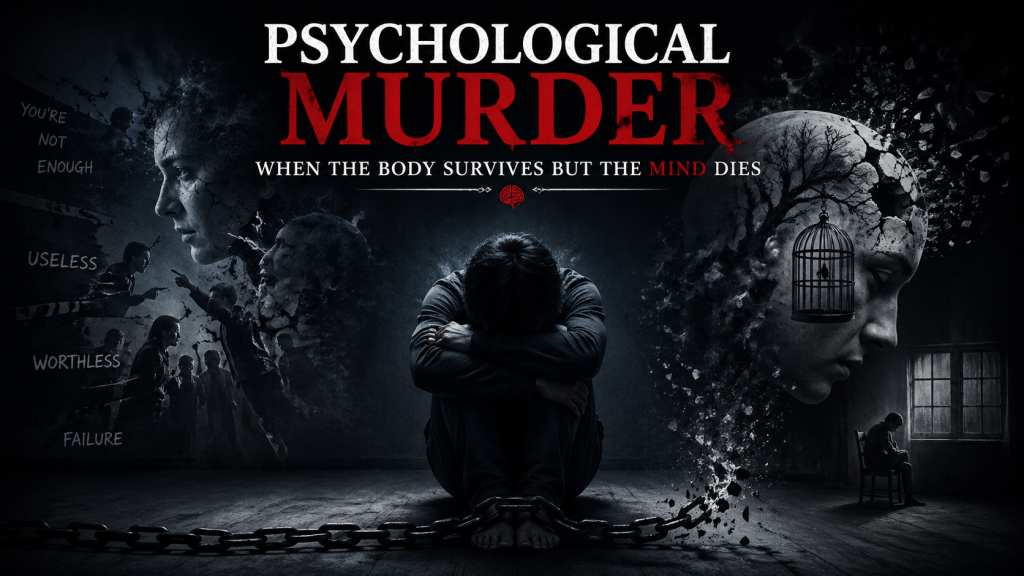
Some murders never appear in police files or true crime documentaries.
They do not involve weapons or bloodshed.
They happen silently inside the people who survive violent crimes. Dr. Mayer from the podcast, PodCandy: Cults, Crime and Killers calls this haunting phenomenon psychological murder. It is the moment a person continues breathing while something essential inside them stops living.
Dr. John Mayer, whose voice often cuts through the emotional fog on PodCandy, believes this concept finally gives language to a kind of suffering that society routinely overlooks.
When Survival Feels Like a Curse
Psychological murder deserves recognition because it captures a deeper level of harm than any physical wound. Crime survivors often walk away with their pulse intact, yet their inner world is shattered.
They become part of a category society barely understands. They are trauma survivors who now live a fractured existence where memories hurt more than the crime itself.
In podcasts of PodCandy: Cults, Crime and Killers discussions, Dr. Mayer explained that this term emerged from years of working with people drifting through life after losing their sense of safety, identity and trust. Their bodies survived. Their minds did not.
Defining Psychological Murder
If ordinary trauma is a wound, psychological murder is an amputation of the self. It goes beyond pain and lingers as something irreversible.
Many survivors describe it as emotional death, a disconnection from joy or meaning, a sense that the person they used to be no longer exists.
When PodCandy first explored this idea, Dr. Mayer stressed that traditional vocabulary is too small for what these people experience. Words like psychological damage or mental scars barely scratch the surface.
The Moment the Inner Self Breaks
A survivor of a violent break in once told him that she felt like she died that night even though she lived. Her body went on to cook meals and answer emails, yet everything inside her felt numb and hollow.
That is psychological murder, a hidden fatality that takes place in the psyche. It is not metaphorical. It is a profound transformation that steals the inner life long before the heartbeat stops.
The Survivor’s Reality
Surviving a crime does not guarantee survival of the mind. Many carry lifelong trauma marked by symptoms that never fully fade. PTSD becomes an unwelcome companion. Survivor guilt sits heavy in the gut.
There is constant hyper vigilance, the inability to sleep without checking the locks, sudden panic when footsteps echo behind them. Some lose their sense of identity because fear rewires everything they believe about themselves.
Living in Recurring Fear
In PodCandy episodes that discuss true crime survivor stories, Dr. Mayer often reflects on the emotional collapse that takes place after the adrenaline fades.
The survivor begins living in a state he calls recurring fear, a loop where the mind replays the crime without permission. It feels like the attack is always happening for the first time.
Many describe this as a living death. They are alive in the technical sense, yet they move through life as if underwater, watching the world from behind a barrier they cannot break.
When Memories Attack Without Warning
A woman who survived a kidnapping once said she felt like she was haunting her own life. Her trauma did not just fracture her memories. It fractured her future.
Why Psychological Murder Is Worse Than Physical Death
It sounds provocative to suggest that emotional death can be worse than physical death, yet this idea has weight in crime psychology. When someone dies, their suffering ends.
When someone experiences psychological murder, the suffering begins and often never stops. Pain becomes a loop. Fear becomes a cage. The person is forced to relive their trauma again and again, sometimes for decades.
Dr. Mayer often explains on PodCandy that humans can recover from broken bones and healed wounds, but the mental scars of crime create a type of imprisonment that is far more persistent.
The world expects survivors to be grateful they lived. That expectation alone deepens the wound. They are applauded for their strength while silently drowning in survivor trauma.
Society often misses this form of death because it does not bleed. People around these survivors assume time will heal them. They think therapy will erase memories.
They believe survival equals victory. In reality, many survivors feel abandoned. They feel misunderstood. They feel like they are grieving themselves while everyone else celebrates their survival.
The Silent Grief of the Living Dead
Recognizing psychological murder changes more than vocabulary. It changes compassion. It forces society to rethink the meaning of justice.
Courts focus on physical harm, yet psychological murder devastates families, relationships and futures with equal force.
Partners struggle to understand why the survivor withdraws emotionally. Children sense the fear in their parents but cannot interpret it. Friendships fade under the weight of unspoken pain.
Dr. Mayer from the podcast, PodCandy: Cults, Crime and Killers, acknowledges psychological murder should become part of the national dialogue on mental health and legal reform.
Many survivors do not receive long term psychological care even though their internal wounds are deeper than any physical injury. Lifelong trauma affects every level of functioning. Work becomes difficult. Intimacy becomes triggering. Trust feels impossible. The world becomes a maze of threats.
The justice system also struggles with this reality because psychological devastation is hard to quantify. Yet its impact is enormous.
Survivors often face financial instability because their trauma impairs their ability to work. They face social isolation because people do not know how to comfort them. They face emotional disintegration because the trauma burns through their sense of self.
Naming this experience gives it weight. It transforms invisible suffering into something society can no longer ignore.
The Ripple Effect on Loved Ones
The effects of psychological murder extend beyond the survivor. Partners, children and friends are caught in the ripple of trauma. They witness the withdrawal, fear and emotional disintegration without understanding its depth. This secondary trauma impacts relationships, parenting and community bonds in profound ways.
Hope and Healing After Emotional Death
If we can name the pain, we can begin to heal it. PodCandy repeats this message often because survivors deserve a vocabulary for what they endure. Psychological murder is not a dramatic label. It is an honest one. It acknowledges that the mind can die even when the heart continues beating.
This term invites people to reflect, discuss and understand the shadow side of survival. It asks the world to stop congratulating survivors without asking what survival actually costs.
It urges listeners to dive into episodes of PodCandy: Cults, Crime and Killers where Dr. Mayer breaks down trauma in a way that feels human and comforting rather than clinical. His insights create a bridge between psychological theory and lived experience.
Starting conversations about psychological murder can change how we support survivors. It can challenge courts to consider lifelong mental harm. It can reshape how families respond to trauma. It can expand empathy in ways that save lives. Awareness is not just a goal. It is a form of justice.
Conclusion
Language has power. When we give suffering a name, we honor the people living through it. Psychological murder finally acknowledges the invisible tragedies hidden inside many survivors. It recognizes that survival is not always a victory. Sometimes it is a sentence.
As PodCandy and Dr. Mayer continue exploring these stories, they invite you to see survival through a new lens. The body may survive, yet the mind may not.
By understanding this truth, we come closer to building a world where survivors are not left alone in their emotional ruins. Healing begins the moment someone feels seen, understood and named.
If this concept resonated with you, listen to the PodCandy episode that inspired this term. Understanding is the first step. Connection is the next.